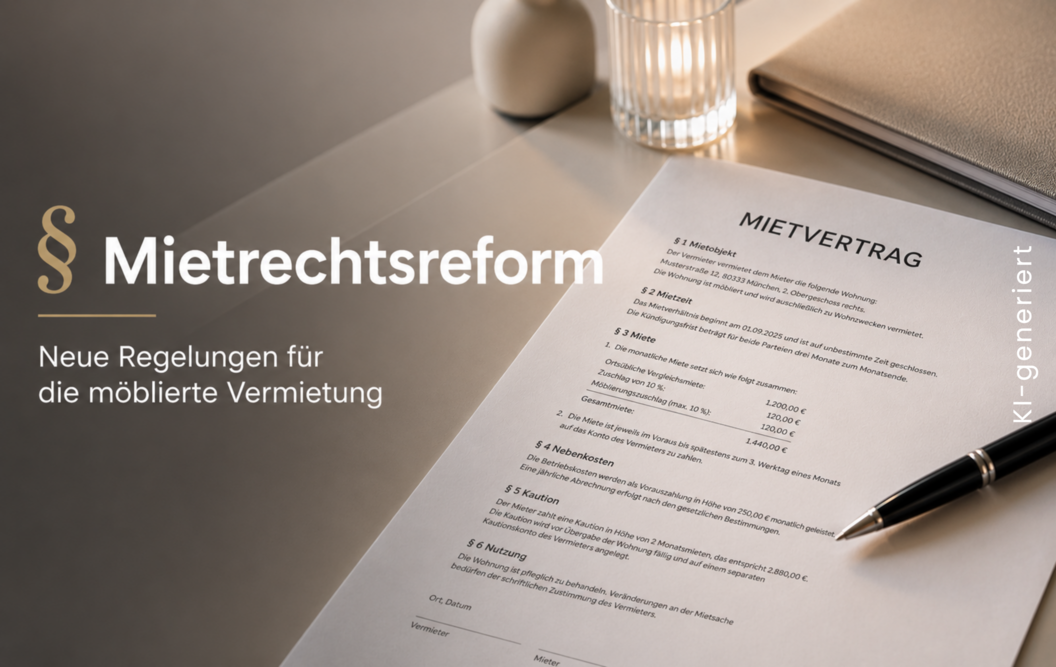
The German government has passed a bill to tighten tenancy law ("Tenancy Law II" of 29.04.2026). Among other things, it includes regulation of furnished rentals that do not affect existing tenancy agreements.
The most important facts in brief
The following regulations will apply to owners who rent out furnished properties if the government bill is passed by parliament unchanged:
a statutory limit on the furnishing surcharge
mandatory disclosure of the furnishing surcharge in the rental agreement
a fixed upper time limit for letting for temporary use
For the first time, the furnishing surcharge will be specified by law.
The following will apply in future:
The furnishing surcharge may not exceed 1% of the current value of the furnishings
The current market value at the time the rental agreement is concluded is decisive. The current value can be determined by estimation
Alternatively, a flat-rate calculation is possible: for fully furnished apartments, a surcharge of up to 10% of the net cold rent is assumed by law to be appropriate
Significance for owners
It will no longer be possible to freely determine furnishing surcharges. If more than 10 % of the net cold rent is set, a comprehensible derivation of the surcharge amount will be indispensable.
The standard presumption that 10 % of the local comparative rent is appropriate can be rebutted by the tenant. Any furnishing surcharge must therefore be reasonable.
2. mandatory disclosure of the amount of the furnishing surcharge
One significant change concerns the disclosure obligations:
Landlords must disclose the furnishing surcharge before the contract is concluded without being asked, i.e. at least in the tenancy agreement
The net cold rent must also be stated in the tenancy agreement, as this is the reference value for the furnishing surcharge. Although the wording of the draft bill does not contain any provision on the disclosure of the net cold rent, we assume that courts will interpret the new regulation to this effect
If the landlord does not disclose the amount of the furnishing surcharge in good time,
the apartment is legally considered unfurnished
this has a direct impact on the permissible rent amount, as a furnishing surcharge is then not permitted
3. limitation of "letting for temporary use"
The maximum permissible duration of a "letting for temporary use" has not yet been regulated by law.
The federal government's draft bill now specifies this:
In future, a fixed upper time limit of 6 months is to apply
An extension of up to 2 months should be possible if the tenant has a longer requirement after the start of the tenancy
"Temporary use" as an exception to the rent freeze will continue to depend on whether the tenant has a temporary special housing need
For owners, this means
Less flexibility for longer-term temporary rental models
The rent freeze applies for a rental period of longer than 6 months, unless one of the statutory exceptions applies
4. relationship to the rent freeze
According to the draft law, the furnished basic rent is the basic rent to which the possible surcharge of 10% under Section 556d (1) BGB (permissible rent at the start of the tenancy) is to be added.
Important: The rent freeze does not apply to all rental apartments.
The following are exempt
New buildings (first use and rental after October 1, 2014)
Rentals for temporary use (max. 6 months, extendable by up to 2 months)
First letting after extensive modernization
5. other important planned changes
In addition to the regulation of furnished rentals, the draft bill contains further regulations that are important for owners:
Limitation of index-linked rents in the event of high inflation: if the rental property is located in municipalities (or parts of municipalities) that have been designated by the respective state government as an area with a tight housing market, only half of any index change above 3% can be taken into account
Extended protection against dismissal for tenants in the event of payment arrears: Extension of the so-called grace period to an ordinary termination in the event of full arrears payment by the tenant; however, this can only be claimed once by the tenant
Increase in the limit for simplified modernization levies to € 20,000
Sample calculation based on the government draft of 29.04.2026 (without guarantee)
Basic rent
+1.200 €
Furnishing surcharge (10 % of the basic rent)
+120 €
Local basic rent incl. furnishings
=1.320 €
Maximum permissible excess of 10 % over the local comparative rent including furnishings
+132 €
Max. permissible basic rent incl. furnishings
=1.452 €
Further sources of information:
You can find the Federal Government's draft bill (Cabinet decision of 29.04.2026) at
This website uses cookies to personalize content, customize and measure advertising, and provide a safe experience. By clicking the "Allow all and continue" button, you consent to the collection of data via cookies.
Necessary Cookies
Necessary Cookies
These are cookies our website needs to function. If they are not accepted by you, parts of the site won’t be usable. For example, the cookies are used to ensure that website pages display correctly, and to determine which language and currency are used (based on your location).
Cookie Consent
Cookie Consent
Cookie consent retention
Supergroup / category
Necessary Cookies
Name
Cookie Consent
Providers
Mr. Lodge GmbH
Period of validity
1 year
Description
Cookie consent retention
Category
Electronic identification data
Google Recaptcha
Google Recaptcha
Verification of whether the data entered on this website is entered by a human or by an automated program.
Supergroup / category
Necessary Cookies
Name
Google Recaptcha
Providers
Google Ireland Limited, Google Building Gordon House, 4 Barrow St, Dublin, D04 E5W5, Ireland
Data collected:
Browser language, browser plugins, click path, date and time of visit, IP address, user behavior, time spent on a page, user input
Processing purposes
Tracking, protection from bots
Legal basis
Legitimate interests of the website operator, Art. 6 para. 1 lit. f GDPR (General Data Protection Regulation)
Period of validity
The data is deleted as soon as it is no longer needed for processing purposes.
Description
Verification of whether the data entered on this website is entered by a human or by an automated program.
Category
Performance
Third Party Country
Attention: This service may transfer data to so-called third countries outside of the EU. In the case of data transfers to the USA, there is a risk that US security authorities may gain access to the data for surveillance purposes. Effective legal remedies may not exist for EU citizens. The legal basis is Art. 49 Par. 1 Sentence 1 lit. a GDPR (General Data Protection Regulation).
Feelestate
Feelestate
Feelestate allows our website visitors to take a virtual 360° tour of selected apartment listings.
Supergroup / category
Necessary Cookies
Name
Feelestate
Providers
AVANTO VR Solutions GmbH Otto-Lilienthal-Str. 16A 28199 Bremen Deutschland
Period of validity
The data is deleted as soon as it is no longer needed for processing purposes.
Description
Feelestate allows our website visitors to take a virtual 360° tour of selected apartment listings.
Matterport
Matterport
Matterport allows our website visitors to take a virtual 360° tour of selected apartment listings.
Supergroup / category
Necessary Cookies
Name
Matterport
Providers
Matterport Inc., 352 E Java Dr, Sunnyvale, CA 94089, Vereinigte Staaten
The data is deleted as soon as it is no longer needed for processing purposes.
Description
Matterport allows our website visitors to take a virtual 360° tour of selected apartment listings.
Third Party Country
Attention: This service may transfer data to so-called third countries outside of the EU. In the case of data transfers to the USA, there is a risk that US security authorities may gain access to the data for surveillance purposes. Effective legal remedies may not exist for EU citizens. The legal basis is Art. 49 Par. 1 Sentence 1 lit. a GDPR (General Data Protection Regulation).
Google Tag Manager
Google Tag Manager
The Google Tag Manager ensures that cookies are allowed according to the setting that site visitors choose.
Supergroup / category
Necessary Cookies
Name
Google Tag Manager
Providers
Google Ireland Ltd., Gordon House, 4 Barrow St, Dublin, D04 E5W5, Ireland
Verarbeitungszwecke
Einbindung von Landkarten und Stadtplänen
Ort der Datenverarbeitung:
EU
Period of validity
Die Daten werden gelöscht, sobald sie nicht mehr für die Verarbeitungszwecke benötigt werden. Hier in der Regel 6 Monate.
Description
Karten-Plattform, die eine direkte Einbindung von Landkarten und Stadtplänen auf der Website ermöglicht.
Category
Essentiell
Third Party Country
Achtung: Dieser Dienst kann Daten in sogenannte Drittstaaten außerhalb der EU übertragen. Bei Datenübertragungen in die USA besteht das Risiko, dass US-Sicherheitsbehörden zu Überwachungszwecken Zugriff auf die Daten erhalten. Effektive Rechtsbehelfe bestehen für EU-Bürger möglicherweise nicht. Rechtsgrundlage ist Art. 49 Abs. 1 Satz 1 lit. a DSGVO.
ProvenExpert
ProvenExpert
Service to evaluate our service
Supergroup / category
Necessary Cookies
Name
ProvenExpert
Providers
Expert Systems AG, Quedlinburger Straße 1, 10589 Berlin
Performance cookies extend the use of the website with functions such as the integration of information videos or the ability to forward exposés to friends and acquaintances simply with a click.
YouTube
YouTube
Video player platform that allows direct embedding of videos on the website.
Supergroup / category
Performance Cookies
Name
YouTube
Providers
Google Ireland Limited, Google Building Gordon House, 4 Barrow St, Dublin, D04 E5W5, Ireland
Legal basis
Consent of the user, Art. 6 para. 1 lit. a GDPR (General Data Protection Regulation)
Data collected:
IP address, referrer URL, device information, videos viewed
Processing purposes
Video display
Data processing location:
EU
Period of validity
The data is deleted as soon as it is no longer needed for processing purposes. Usually in this case 6 months.
Description
Video player platform that allows direct embedding of videos on the website.
Category
Performance
Third Party Country
Achtung: Dieser Dienst kann Daten in sogenannte Drittstaaten außerhalb der EU übertragen. Bei Datenübertragungen in die USA besteht das Risiko, dass US-Sicherheitsbehörden zu Überwachungszwecken Zugriff auf die Daten erhalten. Effektive Rechtsbehelfe bestehen für EU-Bürger möglicherweise nicht. Rechtsgrundlage ist Art. 49 Abs. 1 Satz 1 lit. a DSGVO.
Interhyp AG
Interhyp AG
Determination of an interest rate for financing the purchase of an apartment or a house.
Legal basis:
Consent of the user, Art. 6 ss. 1 lit. a GDPR.
Data collected:
IP address.
If you enter data in the mortgage calculator and click Submit, this data will also be transmitted to Interhyp.
Processing purposes:
Use of the mortgage calculator
Place of data processing:
EU
Retention period:
The data is deleted as soon as it is no longer needed for the processing purposes. In this case, usually 6 months.
Period of validity
approx. 6 months
Description
Determination of an interest rate for financing the purchase of an apartment or a house.
Category
Performance
Third Party Country
No data is transferred to entities in countries outside the European Union (so-called third countries). The exception to this is data transfer in cases where Interhyp AG in turn uses cookies from non-European providers; more detailed information on the use of cookies by Interhyp AG can be found at www.interhyp.de/datenschutz.
Immobilienpreisrechner
Immobilienpreisrechner
This site uses plugins to provide a tool for determining the market value of real estate.
Legal basis:
Consent of the user, Sec. 6 (1) (a) GDPR
Data collected:
Non-identifiable IP address, operating system, browser type
Processing purposes:
Display of Google reviews on our website
Retention period:
The data is only stored and analyzed for 7 days
Period of validity
7 days
Description
The presentation of Google reviews
Category
Performance
Third Party Country
This service may transfer data to so-called third countries outside the EU. When data is transferred to the USA, there is a risk that US security authorities may gain access to the data for surveillance purposes. Regarding data transfer, Elfsight states, among other things: "However, we have ensured that personal data collected by our service for the proper functioning of the widgets is secured, stored for only 7 days, retained for no longer than is necessary for the functioning of the service, and not used for marketing or tracking purposes. Further details can be found on our privacy policy page - elfsight.com/privacy-policy/ ."
Rechtsgrundlage:
Einwilligung des Nutzers, Art. 6 Abs. 1 lit. a DSGVO;
Setzen/Auslesen von Cookies gemäß § 25 Abs. 1 TTDSG.
Erhobene Daten:
IP-Adresse, Geräte- und Browserinformationen, Nutzungsdaten
Verarbeitungszwecke:
Anzeige von Trustpilot-Bewertungen auf unserer Webseite.
Aufbewahrungsdauer:
Die Daten werden nach den jeweiligen Trustpilot-Fristen gespeichert und verarbeitet (Session / bis zu 12 Monate).
Period of validity
Session / bis zu 12 Monate
Description
Die Darstellung von Trustpilot-Bewertungen
Category
Performance
Third Party Country
Dieser Dienst kann Daten in sogenannte Drittstaaten außerhalb der EU übertragen. Dies betrifft insbesondere Trustpilot-Subdienstleister in Ländern ohne angemessenes Datenschutzniveau, z. B. die USA. Bei Datenübertragungen in Drittstaaten besteht das Risiko, dass Sicherheitsbehörden auf Daten zugreifen können, ohne dass EU-Betroffene ausreichende Rechtsmittel haben. Trustpilot gibt an, Standardvertragsklauseln (SCC) und zusätzliche Schutzmaßnahmen einzusetzen. Weitere Einzelheiten finden Sie in der Trustpilot-Datenschutzerklärung – de.legal.trustpilot.com/for-everyone/privacy-policy/.
Marketing Cookies
Marketing Cookies
Marketing cookies enable different forms of advertising to be placed in a more targeted manner. This includes the display of direct advertising on third-party advertising platforms. The display of randomly selected advertising on other platforms remains possible even if these cookies are not allowed.
GoogleAds
GoogleAds
Allows to measure the conversion of advertising (Google Ads)
Supergroup / category
Marketing Cookies
Name
GoogleAds
Providers
Google Ireland Ltd., Gordon House, 4 Barrow St, Dublin, D04 E5W5, Ireland
Allows to measure the conversion of advertising (Google Ads)
Category
Marketing
Third Party Country
Attention: This service may transfer data to so-called third countries outside of the EU. In the case of data transfers to the USA, there is a risk that US security authorities may gain access to the data for surveillance purposes. Effective legal remedies may not exist for EU citizens. The legal basis is Art. 49 Par. 1 Sentence 1 lit. a GDPR (General Data Protection Regulation).
Facebook Pixel
Facebook Pixel
The "Facebook Pixel" cookie (officially: "Visitor Action Pixel"; until 2016: "Conversion Tracking Pixel") can be integrated on websites outside the Facebook platform. For this purpose, a specific tracking code is generated. Various target pages can be defined in the process. From signing up for a newsletter to downloading free content to purchasing a specific product on one of the target pages, it is possible to track which actions the potential customer has performed on the target page. This allows advertisers to track whether an advertising campaign is achieving the desired success.
Supergroup / category
Marketing Cookies
Name
Facebook Pixel
Providers
Facebook Ireland Limited, 4 Grand Canal Square, Grand Canal Harbour, Dublin 2 Ireland
Privacy Protection
Meta Privacy Policy - How Meta collects and uses user data
Legal basis:
Consent of the user, Art. 6 ss. 1 lit. a) GDPR.
Data collected:
Your activities on our website, combined with personal data of your browser and your IP address, are also made available to Facebook Ireland Limited, 4 Grand Canal Square, Grand Canal Harbour, Dublin 2 Ireland, and transmitted to, processed, and stored at locations outside the European Union, such as the United States. Facebook publishes its security and privacy policies at Meta Privacy Policy - How Meta collects and uses user data.
Processing Purposes:
Advertising purposes
Place of data processing:
Outside the EU
Retention period:
According to Facebook, the processed data will be stored only as long as it is necessary for the execution of the pixel service, after which it will be deleted if there are no legal deadlines for clarification to the contrary.
Description
The "Facebook Pixel" cookie (officially: "Visitor Action Pixel"; until 2016: "Conversion Tracking Pixel") can be integrated on websites outside the Facebook platform. For this purpose, a specific tracking code is generated. Various target pages can be defined in the process. From signing up for a newsletter to downloading free content to purchasing a specific product on one of the target pages, it is possible to track which actions the potential customer has performed on the target page. This allows advertisers to track whether an advertising campaign is achieving the desired success.
Category
Advertising
Third Party Country
A transfer of data to entities in countries outside the European Union (so-called third countries) takes place. More information on the use of cookies by Facebook can be found at www.facebook.com/privacy/explanation.
LinkedIn Insight Tag
LinkedIn Insight Tag
The "LinkedIn Insight Tag cookie can be integrated on websites outside the Facebook platform. For this purpose, a specific tracking code is generated. Various target pages can be defined in the process. From signing up for a newsletter to downloading free content to purchasing a specific product on one of the target pages, it is possible to track which actions the potential customer has performed on the target page. This allows advertisers to track whether an advertising campaign is achieving the desired success.
Supergroup / category
Marketing Cookies
Name
LinkedIn Insight Tag
Providers
LinkedIn Corporation, 1000 W. Maude Ave., Sunnyvale, CA 94085, USA
Legal basis:
Consent of the user, Art. 6 ss. 1 lit. a) GDPR.
Data collected:
Your activities on our website, combined with personal data of your browser and your IP address, are also made available to Facebook Ireland Limited, 4 Grand Canal Square, Grand Canal Harbour, Dublin 2 Ireland, and transmitted to, processed, and stored at locations outside the European Union, such as the United States. Facebook publishes its security and privacy policies at Meta Privacy Policy - How Meta collects and uses user data.
Processing Purposes:
Advertising purposes
Place of data processing:
Outside the EU
Retention period:
According to LinkedIn, the processed data will be stored only as long as it is necessary for the execution of the pixel service, after which it will be deleted if there are no legal deadlines for clarification to the contrary.
Description
The "LinkedIn Insight Tag cookie can be integrated on websites outside the Facebook platform. For this purpose, a specific tracking code is generated. Various target pages can be defined in the process. From signing up for a newsletter to downloading free content to purchasing a specific product on one of the target pages, it is possible to track which actions the potential customer has performed on the target page. This allows advertisers to track whether an advertising campaign is achieving the desired success.
Category
Advertising
Third Party Country
A transfer of data to entities in countries outside the European Union (so-called third countries) takes place. More information on the use of cookies by Facebook can be found at www.linkedin.com/legal/privacy-policy.
Microsoft Advertising
Microsoft Advertising
Erlaubt die Messung der Conversion von Werbemitteln (Microsoft Advertising)
Supergroup / category
Marketing Cookies
Name
Microsoft Advertising
Providers
Microsoft Corporation, One Microsoft Way, Redmond, WA 98052, USA
Privacy Protection
privacy.microsoft.com/privacy
Period of validity
120 Tage
Description
Erlaubt die Messung der Conversion von Werbemitteln (Microsoft Advertising)
Category
Marketing
Third Party Country
Achtung: Dieser Dienst kann Daten in sogenannte Drittstaaten außerhalb der EU übertragen. Bei Datenübertragungen in die USA besteht das Risiko, dass US-Sicherheitsbehörden zu Überwachungszwecken Zugriff auf die Daten erhalten. Effektive Rechtsbehelfe bestehen für EU-Bürger möglicherweise nicht. Rechtsgrundlage ist Art. 49 Abs. 1 Satz 1 lit. a DSGVO.
Analysis Cookies
Analysis Cookies
These cookies allow us to better understand user behavior and optimize the features and content of the website.
Google Analytics 4
Google Analytics 4
Dienst zur Analyse von Websitebesuchen und Interaktionen
Supergroup / category
Analysis Cookies
Name
Google Analytics 4
Providers
Google Ireland Ltd., Gordon House, 4 Barrow St, Dublin, D04 E5W5, Ireland
Privacy Protection
Erhobene Daten:
Kontodaten, Anonymisierte IP-Adresse, Absprungraten, Browser-Informationen, Klickpfad, Datum und Uhrzeit des Besuchs, Geräteinformationen, Downloads, Besuchsdauer, Standort-Informationen, Internetdienstanbieter, Mausbewegungen, Bildschirmauflösung, Verhaltensdaten, Referrer URL, App-Aktualisierungen
Rechtliche Grundlage:
Im Art. 6 Abs. 1 S. 1 lit. a DSGVO wird die erforderliche Rechtsgrundlage für die Verarbeitung von Daten genannt
Ort der Verarbeitung:
Europäische Union
Datenempfänger:
Alphabet Inc., Google LLC, Google Ireland Limited
Dienst zur Analyse von Websitebesuchen und Interaktionen
Category
Analyse
Third Party Country
Dieser Dienst kann die erfassten Daten in ein anderes Land übertragen. Bitte beachten Sie, dass dieser Dienst möglicherweise Daten in Länder übermittelt, die kein angemessenes Datenschutzniveau bieten. Im Falle einer Übermittlung von Daten in die USA besteht das Risiko, dass die Daten von US-Behörden zu Kontroll- und Überwachungszwecken ohne Anspruch auf Rechtsbehelfe verarbeitet werden. Nachfolgend finden Sie eine Liste der Länder, in die Daten übermittelt werden. Weitere Informationen zu deren Sicherheitsgarantien finden Sie in der Datenschutzerklärung des Website-Anbieters oder wenden Sie sich direkt an den Website-Anbieter.
Cookie notice
This website uses cookies to personalize content, customize and measure advertising, and provide a safe experience. By clicking the "Allow all and continue" button, you consent to the collection of data via cookies.