

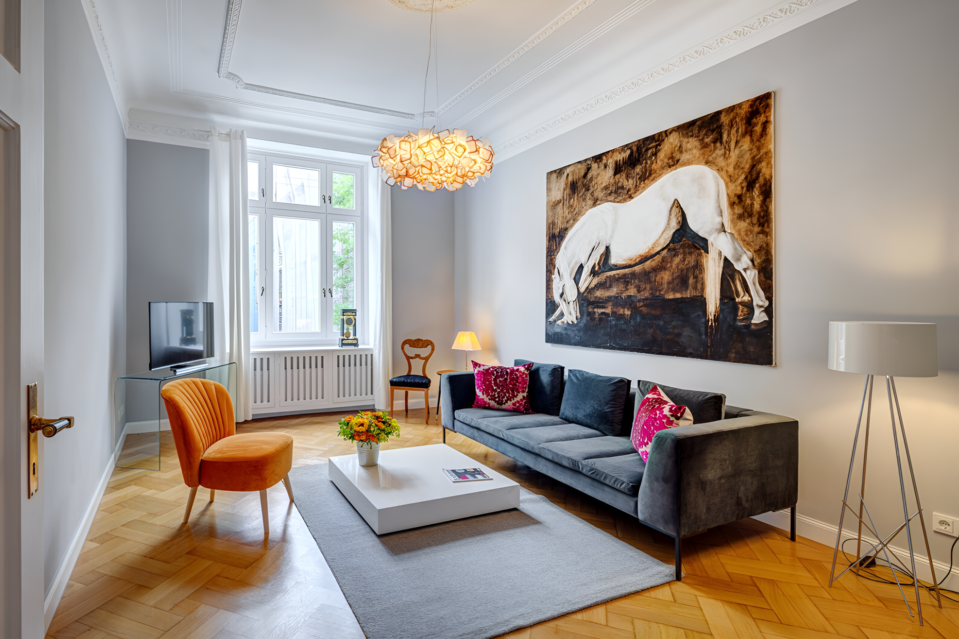
Temporary living
Flexible living concept without long-term commitment
A new job, a temporary project or the desire for flexible use of living space - traditional rental contracts are often no longer suitable for modern living situations. At the same time, owners are looking for high-yield but flexible rental models. Temporary living offers a solution here: for people who want to live temporarily and for providers who want to use living space strategically.
Table of contents:
- What is temporary living?
- Who is eligible for temporary living?
- What are the advantages of temporary living for tenants?
- What are the advantages of temporary living for landlords?
- How does temporary living work in practice?
- What do you need to bear in mind with temporary living?
- Conclusion
- FAQ - Frequently asked questions about temporary living
What is temporary living?
Definition and characteristics
Temporary living is the temporary provision of furnished accommodation for a defined period, usually between a few months and a year. It serves as a flexible interim solution with a fully equipped infrastructure and flat-rate billing.
Key aspects of temporary living
- Furnishing & equipment: Fully furnished including kitchen, bed linen and Internet (WLAN).
- Contract structure: Fixed-term rental contracts with automatic termination without the need to give notice.
- Cost structure: Usually flat-rate rents that cover all ancillary costs and often additional services.
- Target groups: Young professionals, project workers, commuters, students as well as expats or people in transitional phases.
| Characteristic | Temporary living | Classic rental | Vacation apartment |
|---|---|---|---|
| Duration | 1 - 36 months | Indefinite | Days to weeks |
| Equipment | Fully furnished | Unfurnished | Fully furnished |
| Purpose | Professional/private (residence) | Long-term residence | Touristic |
| Billing | All-inclusive price | Basic rent + NK advance payment | Daily/weekly rates |
| Termination | Automatic end | Statutory deadlines | None (booking) |
Common formats
- Serviced apartments: Apartments with hotel-like additional services (cleaning, laundry service).
- Boardinghouses: Accommodation in urban centers for longer stays.
- Intermediate rent: Temporary subletting in privately used properties.
Temporary living is renting an apartment for a limited period of time, usually including full furnishing and equipment. Unlike a traditional open-ended tenancy, it is clear from the outset that the tenancy will end after a certain period.
In practice, this means that You rent an apartment for a few months or a few years, for example, and then move out again without making any long-term commitments. These are often fixed-term tenancy agreements (temporary tenancy agreements) in which the start and end of the tenancy are precisely stipulated in the contract.
In Germany, the minimum rental period for temporary accommodation is usually at least 3 months, in some cities even 6 months. Shorter periods tend to fall under vacation or short-term rentals.
As a general rule, the apartment is fully furnished and ready to move into so that the tenant can move in straight away - similar to an apartment hotel or boarding house. It is important not to confuse temporary living with vacation apartments. The concept is aimed at temporary residents, not vacationers.
Expert Commentary
» Depending on the duration, short-term housing is generally governed by rental law rather than travel law. For tenants, this means clear contractual terms and greater legal certainty despite the fixed-term nature of the lease. Landlords benefit from predictable time frames, clearly defined terms, and a clear distinction from short-term rentals. «

Although some private individuals now also use furnished apartments for interim rentals on longer trips, this living concept is not primarily a vacation accommodation. Rather, it is a temporary housing solution for people who are temporarily living and working in a city - not for traditional vacationers.
Who is temporary housing suitable for?
Temporary housing is aimed at various target groups who need a flexible housing solution. Today, more and more people rely on professional or personal mobility and take advantage of temporary housing. Typical groups include, for example:

Project-based workers
or business travelers
Specialists and executives who work in another city for a few months (e.g., project staff, consultants, or expats) appreciate a furnished apartment because they do not want to settle there permanently.

Students, interns, and
young professionals
Whether it’s a semester, an internship, starting college, or beginning a career: Anyone who needs temporary housing will find furnished shared apartments or short-term rentals to be a good interim solution until they find something permanent.

People in
transitional phases
Private individuals going through a transitional phase—for example, those with a fixed-term employment contract, those looking for a place to live in a new city, or those going through a separation—are also part of the target group. They rent furnished accommodations for a few months to maintain flexibility.
These and similar groups usually only use furnished apartments temporarily and specifically for limited months. One advantage from the landlord's point of view is that many of these tenant groups are prepared to pay higher rents in order to enjoy the flexibility and comfort of a fully furnished home.
Nevertheless, temporary living - as mentioned above - remains primarily a solution for temporary living for practical reasons and is not a classic vacation rental.
What advantages does temporary living offer tenants?
For tenants, temporary living offers numerous advantages over a conventional rental or a long stay in a hotel. Here are the most important advantages from the tenant's point of view:
Flexibility of the rental period
- Unlike open-ended rental contracts with a long-term commitment (and the usual notice period of 3 months), you can rent for exactly the period you need from the outset.
- This meets the modern need to only live in one place for as long as your job or studies require.
- You avoid being tied to an apartment for longer than necessary and can easily move on or return at the end of the rental period.
Move in quickly without the stress of moving
- Temporary furnished apartments are ready to move into, with everything you need from a sofa to a bed to a kitchen.
- This means that tenants can often find a suitable apartment within a short space of time and move in immediately without having to buy furniture or organize a costly move.
- The usual moving costs (furniture transportation, lorries, etc.) are largely eliminated, which saves a lot of time and stress.
Comfort and privacy instead of a hotel
- A temporary apartment generally offers more space, privacy and a homely feeling compared to a hotel room.
- Especially for longer stays, tenants appreciate the opportunity to furnish themselves in a real apartment, cook their own meals and receive visitors - in short, to live as if they were in their own four walls.
- At the same time, furnished apartments are often tastefully decorated, so there is no need to worry about a sterile atmosphere.
- Many offers are also in attractive locations (e.g. close to the city center or with good transport links), which makes everyday life easier.
Cost savings compared to a hotel
- For longer stays, temporary accommodation is usually cheaper than a month-long hotel stay.
- The rent often already includes utilities and internet, and the furnishing surcharge adds around 10-30% to the cost compared to an unfurnished apartment.
- However, you are happy to pay this for the comfort offered, especially as a hotel in a similar location would cost far more.
- In addition, there are no hidden fees with reputable offers; the conditions are clearly regulated in the rental agreement.
No hassle when moving out
- If you have only rented the apartment for a limited period, the tenancy ends automatically on the agreed date.
- You then simply move out without having to look for a new tenant or renovate (assuming normal wear and tear).
- The deposit is returned to you once the apartment has been handed over properly.
- This informality takes a lot of pressure off tenants who may already be planning their next move.
Expert Commentary
» For longer stays, a furnished apartment is much more comfortable than a hotel. You basically just arrive with your suitcase and immediately feel right at home. «
In summary, temporary living offers tenants maximum flexibility and convenience.
Especially those who frequently change location or need a temporary place to stay can live in an uncomplicated way without having to invest an enormous amount of money and effort every time they move.
What are the advantages of temporary living for landlords?
Temporary letting can also be very attractive for landlords, owners or investors.
This business model differs from traditional permanent letting in a number of ways and opens up special opportunities:
Higher rental income
- One clear advantage is the possibility of adding a furnishing surcharge to the rent, as the apartment is provided fully furnished.
- Furnished apartments often bring in 10-30% more rent than unfurnished apartments, and such surcharges are common.
- Even in cities with rent control, a reasonable surcharge for furnishings is permitted as long as it is based on the current value of the furnishings.
- Landlords can therefore achieve significantly higher yields with temporary, furnished rentals than with unfurnished contracts.
High demand, low vacancy rates
- In many regions, there is high demand for temporary furnished accommodation, whether from companies looking for accommodation for employees or from private individuals in the above-mentioned target groups.
- The potential tenant target group is correspondingly large, which makes it easier for landlords to let their properties quickly.
- The attractive focus on commuters, expats, etc. means that vacancies can often be reduced to a minimum.
- The apartment is usually quickly occupied again, provided the price and offer are right.
More flexibility and control
- With temporary living, landlords are not tied to a tenant for the long term.
- Fixed-term tenancy agreements end automatically, so the owner is free to decide whether to rent out the property again, use it themselves or even sell it.
- This flexibility is particularly advantageous if you have earmarked the apartment for your own use or want to react to changes in the market.
- Rent adjustments are also easier to implement: The price can be reset after each rental period to bring it into line with current market levels, whereas rent increases are regulated for open-ended tenancies.
Lower default and tenant risk
- Due to the shorter rental period, there is a lower risk of tenant default.
- Temporary tenants often pay the rent in advance for several months, or at least long-term rent arrears are less frequent as the end of the contract is foreseeable.
- If there are problems with a tenant, the landlord is not tied to them for years and conflicts are limited, as a difficult tenant will soon have to vacate the apartment.
- In addition, if individual furnished rooms are rented out in the apartment occupied by the landlord himself, even shorter notice periods apply (in this case, the landlord can terminate the contract without giving reasons with just two weeks' notice, Section 573c BGB).
- All in all, the landlord risk can be managed in this way.
Tax advantages and depreciation
- The costs of furnishing and equipping the apartment can be claimed for tax purposes.
- Purchases of furniture and appliances can be written off over the years; smaller furnishings up to €800 net can even be written off in full immediately in the year of purchase.
- Ongoing expenses such as repairs, cleaning services or estate agent costs can also be deducted as income-related expenses.
- This reduces the tax burden and increases the net profit from the rental.
- An example: If a landlord invests €3,000 in new furniture, he can deduct around €300 of this per year for tax purposes.
Of course, renting out furnished also involves somewhat higher costs - from furnishing the apartment to regular tenant changes and looking after the tenants.
But if you pay attention to high-quality furnishings and offer value for money in line with the market, you can create a win-win situation: satisfied tenants and a profitable investment for the landlord. It is important to know the legal framework and manage it professionally (more on this in the next section).
Rent securely and flexibly with Mr. Lodge:
- Maximum reach and verified tenants.
- Strict tenant pre-qualification for your property.
- Personal contact partners provide you with fast, uncomplicated, friendly and helpful support every step of the way.
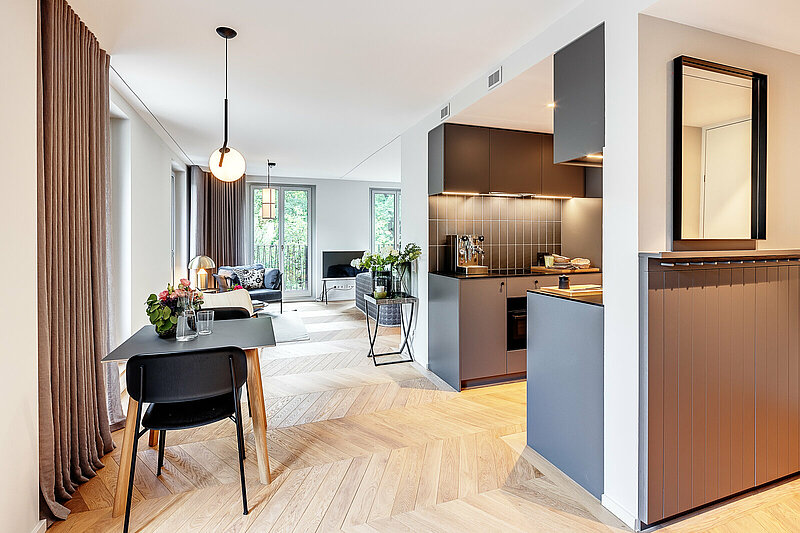
How does temporary living work in practice?
Procedure for tenants
- Renting a temporary apartment works in a similar way to a normal apartment search, but is usually much quicker and less complicated.
- Interested parties can search for furnished apartments via specialized online portals or real estate agents, often filtering by city, rental period and furnishings.
- After making contact and viewing (in person or virtually), a fixed-term tenancy agreement is concluded, which specifies the start and end dates of the tenancy.
- It is also usual to pay a deposit (usually 1-3 months' rent), which the tenant pays and receives back after moving out, provided no damage has occurred.
- Many providers charge all rental costs warm (including utilities, internet, etc.) as a lump sum in advance for the first month; after that, the tenant pays monthly as usual.
- On the move-in date, the tenant receives the landlord's confirmation of residence, which they can use to register with the residents' registration office (required by law).
- Then it's time to unpack the suitcases and move in - thanks to complete furnishing, there is no need to lug around furniture.
- During the rental period, the usual tenant rights apply depending on the duration of the contract (for contracts over 6 months, tenant protection and rent control apply, for shorter so-called short-term rentals, some protective regulations do not apply).
- At the end of the agreed period, the tenant moves out in due time; if he wishes to extend the lease, this must be agreed again in good time, as the original contract ends automatically.
Procedure for landlords
- If you want to let your apartment on a temporary basis, you should first ensure that it is attractively furnished and equipped.
- The apartment must be furnished in such a way that a tenant can move in without any additional effort (bed, wardrobe, seating furniture, fully equipped kitchen, etc. are part of the basic furnishings).
- The landlord can then offer the property through suitable channels. Agencies or brokerage platforms that specialize in furnished short-term rentals are often used for this. Once a tenant has been found, a fixed-term rental agreement is drawn up.
- During the rental period, the landlord ensures that the apartment remains in the condition stipulated in the contract, e.g. repairs to defects that were not caused by the tenant must be carried out promptly.
- Experts therefore recommend seeking the support of an experienced partner who can respond professionally.
- At the end of the rental period, the apartment is inspected together with the tenant; it is advisable to use an inventory list to check the condition of the furniture and rooms, as documented when the tenant moved in.
- This allows any damage to be clearly identified. After a successful handover, the tenant receives the deposit back and the landlord can prepare the apartment for the next tenant.
Overall, the process of temporary living is well organized: From finding an apartment to moving out, both sides benefit from clearly regulated yet flexible structures.
Expert Commentary
» Landlords should familiarize themselves with the legal requirements in advance (reasons for fixed-term leases, local regulations—such as those regarding misuse of property in major cities, etc.), and tenants should read the terms of the lease carefully (e.g., whether there is an option to renew). «
What do I need to bear in mind when living in temporary accommodation?
Whether you are a tenant or a landlord, there are a few important aspects to bear in mind when renting a temporary home:
Legal framework
- Fixed-term tenancy agreements require a material reason. The landlord must state in the contract why the tenancy is limited in time (e.g. personal use after the end of the tenancy, planned conversion). If this reason is missing, the contract is automatically deemed to be for an indefinite period.
- In addition, the usual tenant protection generally applies; however, certain rules such as rent control or protection against dismissal do not apply to very short rental periods (up to 6 months).
- You should therefore find out about the current legal regulations if you are looking for a very short rental period.
Obligation to register (registration system)
- Even if you are "only" living temporarily, you must register with the residents' registration office if you have no other place of residence in Germany. The landlord is obliged to issue the tenant with a landlord's confirmation of residence within 14 days of moving in.
- This obligation also applies to furnished apartments and must not be neglected - otherwise the landlord may be fined. Tenants should therefore ensure that they receive this document in good time in order to comply with their registration obligation.
Subletting and permission
- Many temporary living situations arise through subletting - for example, when a main tenant sublets their apartment temporarily (interim rent, e.g. for stays abroad). The following applies here: A tenant may only sublet their apartment with the landlord's consent.
- According to § 540 BGB, the landlord must be asked for permission and may only refuse it for good cause. Anyone who sublets without permission risks termination. Main tenants should therefore obtain written permission in good time before offering their apartment on a temporary basis.
- Landlords, on the other hand, cannot arbitrarily refuse permission if their tenant has a legitimate interest (e.g. temporary change of job).
Tenancy agreement and inventory list
- The tenancy agreement for temporary accommodation should be as clear and detailed as necessary. In particular, it should state which furnishings and equipment are also rented.
- It is advisable to attach an inventory list of all furnishings to the contract, including their condition on moving in. If both parties sign this list, disputes about missing or damaged items are largely ruled out later.
- The contract should also include the service charge regulations, a possible flat-rate rent including furnishing surcharge and the amount of the deposit.
- As a rule, a deposit of up to three months' rent is charged for temporary accommodation (statutory maximum), which is held in trust in a separate account.
Local regulations
- In some large cities, there are regulations on short-term rentals (keyword: prohibition of misappropriation). These are mainly aimed at vacation apartments, but can also affect furnished interim rentals, especially if the rental period is very short.
- As a landlord, you should ensure that the rental is legal. For example, there may be upper limits on how long you can rent to changing tenants per year without obtaining permission.
- Find out from your local authority whether there are any requirements for the planned rental period. If in doubt, tenants can contact the landlord to make sure that their tenancy is within the regulations.
Insurance and liability
- In the case of furnished apartments, liability for furnishings and damage is an issue. Tenants should have liability insurance that also covers damage to rented property, so they are protected if they accidentally damage furniture or fixtures.
- Landlords can also take out household contents insurance for the furnished apartment. In general, the main tenant (in the case of subletting) remains responsible to the owner for the apartment, which is why there should be a clause in the subletting agreement that makes the subtenant liable for any damage caused by them.
- Clear agreements on cleaning (intermediate cleaning, final cleaning fee, etc.) are also useful so that there are no disagreements at the end.
If both parties observe these points, nothing stands in the way of a smooth process. Transparency and communication are crucial when it comes to temporary living:
If all conditions are openly discussed and set out in a contract, both tenants and landlords can enjoy the benefits of this flexible form of living without any nasty surprises.
Conclusion
Temporary living offers a modern, flexible solution for temporary housing needs. Tenants enjoy the convenience of a fully furnished apartment without a long-term commitment, and landlords can use their property efficiently and rent it out profitably.
Expert Commentary
» Furnished living is no longer a niche concept, but rather a cornerstone of modern work and living environments—it fills a clear gap between hotels and traditional housing. «
With a clear understanding of the benefits, obligations and framework conditions, nothing stands in the way of a successful interim rental - whether it's for a new project abroad, starting your studies in another city or bridging the gap until your next permanent home.
-
How long can you rent a temporary apartment for?
In practice, rental periods of a few months to around two years are common. Many landlords set a minimum rental period (often 3 or 6 months), as shorter periods are more time-consuming to organize.
Theoretically, a temporary tenancy agreement can also run for longer, but after 1-2 years at the latest, the tenant usually switches to a normal tenancy. Important: If the rental period is limited to a maximum of 6 months, this is legally referred to as a short-term rental - some exceptions apply under tenancy law. Longer fixed-term contracts (over 6 months), on the other hand, offer full tenant protection. An extension beyond the originally agreed period is only possible with the landlord's consent, usually by concluding a new fixed-term contract.
-
How do I find a temporary apartment?
The easiest way is via specialized portals and estate agents who broker furnished apartments. Numerous platforms can be found online: from large real estate portals (with filters for furnished or temporary) to agencies for temporary living.
For example, search for "temporary living + [city]" to discover regional offers. After selecting a suitable apartment, you usually go through a standardized procedure: Inquiry, viewing (detailed photos or 3D tours are often available online), then signing a contract. As demand can be high, it is worth starting your search early, especially at the start of the semester or at the beginning of a major project in the city.
-
Do I have to register with the authorities if I am only living temporarily?
Yes, anyone who moves into an apartment in Germany must register with the Residents' Registration Office within 14 days, even if the tenancy is temporary. To do this, you need the landlord's signed confirmation of residence.
This obligation to register applies as soon as you have no other registered place of residence in Germany or stay in the temporary apartment for longer than 3 months at a time. Registration as a secondary residence is also required for a second home. Tenants should therefore make sure that the landlord provides them with the necessary documents in good time. In practice, there may be exceptions for stays of less than 3 months (e.g. in the case of hotels or serviced apartments, the accommodation often registers the guests), but as soon as you are living instead of just staying overnight, there is no way around the obligation to register.
-
Is temporary accommodation more expensive than a normal rent?
As a rule, yes, temporary accommodation is more expensive per month than an open-ended rental contract for an unfurnished apartment. The reason for this is the furnishing surcharge and the short commitment: The landlord provides furnishings and flexibility, which is compensated with a surcharge. Rents for furnished temporary apartments are usually around 10-30% higher than the usual local rent for a comparable unfurnished apartment.
However, all ancillary costs, internet and often even the broadcasting fee are usually included in the rent, so that the total costs are transparent. From the tenant's point of view, the surcharge is worthwhile if you offset the purchase of furniture, moving costs and long-term obligations. Important: In areas with rent control, the landlord may charge a furniture surcharge, but the total rent should still be reasonable. Excessive prices are possible on the open market, but they deter good tenants. Therefore, you will usually find offers in line with the market - slightly more expensive than normal, but with an all-round carefree character.
-
What happens if I want to move out before the end of the tenancy?
A fixed-term tenancy agreement is generally binding for the agreed duration. This means that, as a tenant, you cannot terminate the contract prematurely without further ado. The statutory notice period of 3 months does not apply here, as the contract expires on a specific date.
If you still want to leave earlier, you will have to rely on the landlord's goodwill. In many cases, a solution can be found: for example, by finding a new tenant who will take over seamlessly for the rest of the rental period (of course only with the landlord's consent), or by concluding a termination agreement by mutual consent. However, there is no entitlement to this. Only in special cases - for example, in the event of extraordinary termination for good cause (e.g. if the apartment becomes uninhabitable) - can you terminate the contract early. Our tip: If it is foreseeable that you may need to be flexible, discuss this before signing the contract. Some landlords are accommodating and agree an option to terminate early or extend the contract if circumstances change. However, the basic rule is: plan the rental period realistically, as a temporary rental agreement is there to be fulfilled for this period.
-
Can I rent out my own apartment temporarily?
As the owner of your apartment, you are generally allowed to rent it out furnished for a limited period of time. However, you should observe any local regulations (keyword: misappropriation) and, in the case of a condominium, obtain the consent of the condominium owners' association if the community rules provide for restrictions.
If you are a tenant of an apartment and would like to sublet it, e.g. during a stay abroad, you will always need the consent of your landlord. Your landlord may not refuse permission without good reason if you have a legitimate interest in subletting (e.g. temporary job-related relocation), but you must always ask him in advance. It is important to clearly communicate the duration of the sublet. Tenants should also be aware that they remain responsible to the owner - i.e. if the subtenant causes damage or fails to pay rent, the main tenant is initially liable. However, this risk can be reduced with a carefully drafted subletting agreement (see above: inventory list, deposit, liability clauses). In short: Owners can rent out their apartment on a temporary basis, but should comply with all legal requirements; tenants may only do so with permission and must observe the rules of their main tenancy agreement.

Our team will be happy to help and advise you. Our office hours are Monday to Friday from 9:00 to 18:00.
Phone: +49 89 3408230-26
E-mail: doris.palmiero@mrlodge.de
Doris Palmiero
Director Real Estate Rentals
Authorized Signatory
![[Translate to english:] Eingerichtetes Wohnzimmer](/fileadmin/_processed_/b/9/csm_Einrichtungsberatung_Einrichtungsservice_Muenchen_fa73cc2ceb.jpg "[Translate to english:] Einrichtungsberatung Einrichtungsservice Muenchen")