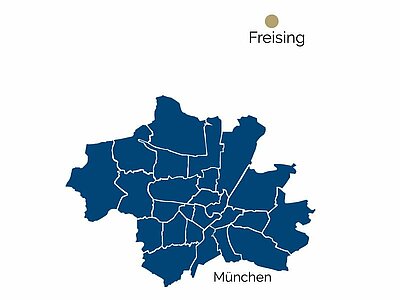

Freising is located around 30 kilometers north of Munich and, like Munich, lies on the Isar river. The town has over 50,000 inhabitants and is important for understanding the residential location because it is not just a commuter community, but an urban center of its own in the north of the region. The good location between Munich, the airport and onward rail routes to Landshut, Regensburg and beyond also fits in with this.
The links to Hallbergmoos, Neufahrn bei Freising, Munich Airport and the wider district of Freising are particularly relevant for residential orientation. At the same time, the city's function extends beyond this neighborhood: Freising is the administrative seat, educational location and rail hub in the northern surrounding area.
Freising is particularly appealing as a place to live because the city brings together several distinct identities. Freising has a very quiet residential area with numerous local recreational areas and a mix of housing that ranges from multi-story apartment buildings to exclusive single-family homes with gardens. As a result, Freising meets a much wider range of housing needs than many smaller surrounding towns.
At the same time, Freising has a distinct urban character. Tourism and city websites highlight the historic Altstadt, the Domberg, the brewing culture, the green gems, and Freising’s role as a young, modern university town. Added to this is the Weihenstephan Campus: The TUM School of Life Sciences brings together its expertise in the life sciences at this modern campus in Freising. From a residential perspective, this means that Freising is at once a historic episcopal city, a center of science, and a livable residential community.
This residential area is appealing, for example, to the following people:
| To the center (Marienplatz) | To the central station | To the airport |
|---|---|---|
| 40,3 km | 42,0 km | 11,9 km |


Very good shopping opportunities, especially around the city center.
Freising has a very unique profile because science, brewing culture and history come together here. The city refers to the Bavarian State Brewery Weihenstephan from 1040 and the Hofbrauhaus Freising from 1160; at the same time, Weihenstephan is a modern science location today. Freising can be presented as a place to live with substance, identity and an internationally connected environment without having to appear artificially trendy.
The topic of greenery is also central to Freising. The tourism side speaks of green gems in the heart of Freising, and the Weihenstephan Gardens form a particularly high-quality open space reference. Freising has numerous local recreation areas. This makes the city particularly suitable for people who want urban infrastructure but at the same time value walking paths, garden spaces and a less dense residential feel.