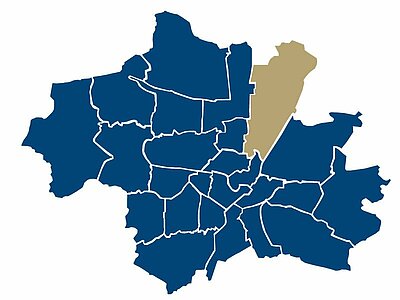
Johanneskirchen is part of the 13th district of Bogenhausen in Munich. The district is located in the north-east of the city and stretches from the edge of the city center to the city limits. Within Bogenhausen, Johanneskirchen is one of the areas that are more rural in character and only later became more densely built-up.
The special peripheral location of Johanneskirchen is particularly important from a residential perspective. The district forms a transition from Munich's built-up urban area to open landscape areas such as the Johanneskirchner Moos and the mosslands in the north-east. As a result, Johanneskirchen is located at an interface between settlement, agricultural areas and natural open spaces. It is precisely this open location that makes the district particularly spacious and open compared to many other residential areas in Munich.
Around Johanneskirchen, Englschalking, Daglfing, Denning, Unterföhring and Bogenhausen are particularly important landmarks. Johanneskirchen is spatially closely connected to other sub-areas in the north-east of Munich and at the same time differs in its own character. This is helpful for prospective buyers because the residential areas differ noticeably from one another in terms of their relationship to the village center, building density and open space quality.
Johanneskirchen is a particularly interesting residential area because the village’s history and later urban development are clearly visible side by side here. The town has been documented since early historical times and was incorporated into Munich in 1930.
The Zahnbrecher housing development marked the first major settlement built outside the old village center; additional residential areas were added starting in the 1960s. As a result, Johanneskirchen today is neither purely a village nor purely a large housing development, but rather a mixed residential area featuring a variety of housing types.
The architectural structure is correspondingly diverse. Around Johanneskirchen, one finds small single- and two-family homes, larger multi-family buildings, farmsteads, and multi-story apartment buildings from the 1990s west of the S-Bahn.
This picture is complemented by larger new development areas to the west and east, where apartment buildings have been constructed alongside green spaces. For those looking for a home, this is precisely where the special appeal lies: Johanneskirchen offers a tangible blend of village charm, an established residential structure, and modern living.
This residential area is of interest, for example, to the following people:
| To the center (Marienplatz) | To the central station | To the airport |
|---|---|---|
| 7,9 km | 9,7 km | 31,1 km |


For daily needs, Johanneskirchen tends to be close to home and has a manageable size. In addition to smaller stores in the surrounding area, the Oberföhring-Johanneskirchen weekly market on Fritz-Meyer-Weg offers a suitable local supply of fresh food, baked goods, delicatessen and other market products.
In terms of gastronomy, Johanneskirchen is quieter than central Munich districts. Instead of a distinct nightlife district, everyday life is characterized by individual cafés, restaurants and inns in the immediate vicinity. Oberföhring, Englschalking and Unterföhring are also within easy reach for additional choice.
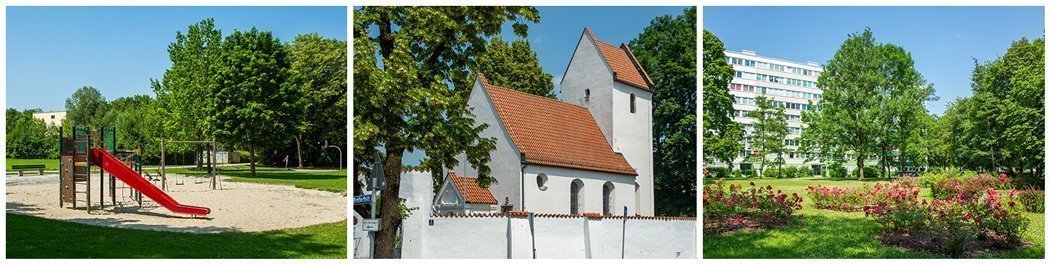
The recreational value of Johanneskirchen lies particularly in its green surroundings. The Johanneskirchner Moos, the Fideliopark and the nearby Feringasee offer opportunities for walks, sport and recreation. The SBZ Fideliopark, a district-oriented leisure facility for children, teenagers and young people, is also relevant for families.