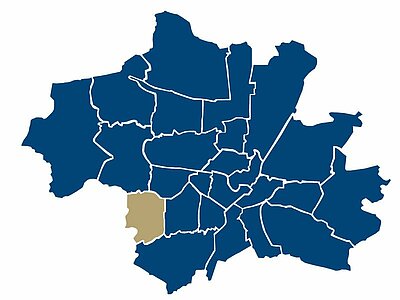
Großhadern is located in City District 20, Hadern, on the southwestern outskirts of Munich. The city defines Hadern as the area west of Fürstenried Straße, between Senftenauerstraße and the A95; Within this area, Großhadern is most readily recognizable by its old town center along Heiglhofstraße and Würmtalstraße. This is important from a residential perspective because Großhadern does not come across as just any suburban neighborhood, but is still visibly the product of a village that has grown over time.
At the same time, Großhadern is one of those locations that benefits from two very distinct poles: the historic village center and the medical and scientific environment surrounding the hospital. Added to this are plenty of green spaces in the wider surroundings and, by Munich standards, a relatively low-density development, particularly in the southern half of the district. This provides a sense of orientation and makes the neighborhood unusually versatile from a residential perspective.
Großhadern is located in southwest Munich and is closely connected to Kleinhadern, Neuhadern, Forstenried, and Laim. These surrounding areas shape the residential environment and make the location versatile in terms of its context.
While Großhadern itself is characterized by established residential areas, good transportation links, and proximity to key amenities, Kleinhadern and Neuhadern complement the broader Hadern context. Forstenried and Laim provide additional connections to neighboring residential areas in western and southwestern Munich.
Großhadern is an attractive place to live primarily because the neighborhood is so much more than just its hospital. The city notes that the structures of the former farming settlement are still clearly recognizable in Old Großhadern; the Cultural History Trail complements the historic village center with St. Peter’s Church, Heiglhofstraße, and the formerly imposing farm estates. In the old town center, single-family homes and renovated 19th-century farmhouses also define the residential landscape.
Added to this is the major location factor of the Großhadern Hospital. The city describes the complex, which opened in 1974, as Munich’s largest contiguous hospital complex and Bavaria’s largest university hospital; the LMU Hospital treats approximately 500,000 patients annually at its two locations. For Großhadern, this means that the neighborhood is not only a pleasant place to live but also a highly significant hub for work, science, and healthcare.
This residential area is appealing, for example, to the following people:
| To the center (Marienplatz) | To the central station | To the airport |
|---|---|---|
| 10,0 km | 7,6 km | 45,0 km |


Großhadern is well-equipped to meet daily needs. Stores selling everyday essentials and smaller shops ensure good local access to basic services. In addition, the weekly market in the old village area is a strong local feature that underscores the neighborhood’s time-honored character.
Those who need additional or larger retail options tend to head toward Haderner Stern. This allows Großhadern to remain a convenient place for everyday life without losing its quiet and intimate residential character.
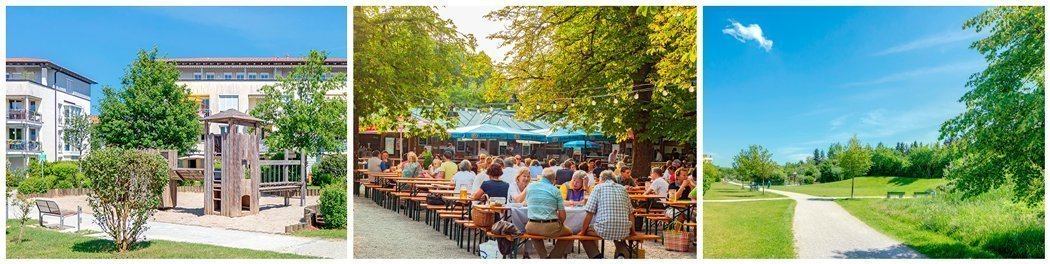
Especially around Heiglhofstraße, Großhadern reveals its close-knit, neighborhood-oriented character and strong local roots. The Culture and History Trail highlights the former tavern—now the Erdinger Weißbräu with its beer garden—as well as other village landmarks that continue to shape the town’s character to this day. This is important from a residential perspective because it makes Großhadern tangible not only in functional terms but also in terms of its atmosphere.
Großhadern benefits greatly from its open spaces. In addition to the Waldfriedhof, the green spaces in the southwest offer additional, easily accessible open areas. For many residents, it is precisely this combination of a peaceful living environment and easily accessible green spaces that is a key advantage of the location.