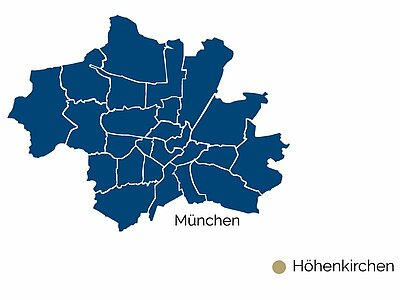
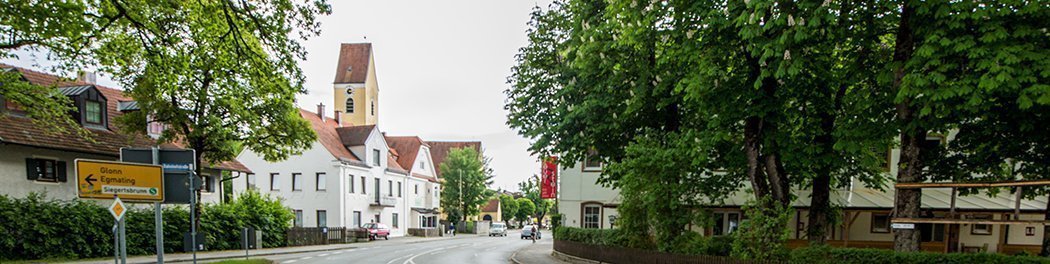
Höhenkirchen-Siegertsbrunn is located in the Munich district and is described by the district as a community situated on a clearing within a vast forested area. It is precisely this scenic setting that is important from a residential perspective: The location feels significantly quieter and greener than many more densely built-up suburban areas, yet remains closely connected to Munich via the S-Bahn. With a commute of just under 30 minutes to the city center, the municipality is well-suited for many commutes and daily trips.
It is also relevant for prospective residents that the municipality does not have a single historic center. The official ISEK highlights Bahnhofstraße as the connecting axis of the town center while also naming the two old town centers of Höhenkirchen and Siegertsbrunn. This results in a residential area that can be best understood in terms of micro-locations rather than just a single place name.
Surrounding Höhenkirchen are several towns—including Aying, Hohenbrunn, Brunnthal, and Sauerlach —that offer a similar quality of life. They are quiet, green, and at the same time well-connected to daily life in the southeastern Munich suburbs. These communities are particularly attractive alternatives in the immediate vicinity for people who want to live close to nature yet still be able to reach Munich quickly.
Höhenkirchen is an attractive place to live primarily because the community offers more than just peace and quiet. The district boasts a vibrant community life featuring culture, tradition, shops, restaurants, crafts, and services. Added to this are childcare options, schools, and a senior center right in the heart of town. From a residential perspective, this means you don’t just live in a green setting—you live in a community that supports you in your daily life.
Höhenkirchen is particularly well-suited for families. According to the official school directory, the town offers two elementary schools with full-day programs, a middle school, and a high school. This range of school types is a real selling point for a suburban community and makes the town attractive in the long term—for both renters and prospective homebuyers.
Added to this is the quality of life provided by the town’s layout: proximity to the train station and central thoroughfares make daily life convenient, while the historic centers and quieter residential streets foster a stronger sense of community. This mix makes Höhenkirchen appealing to families, working professionals, and people seeking a quiet location with good transportation links. Infrastructure and transportation links support this quality of life.
| To the center (Marienplatz) | To the central station | To the airport |
|---|---|---|
| 21,2 km | 23,2 km | 49,7 km |


With its multipurpose hall on Bahnhofstraße, the community’s calendar of events, and an active community of clubs and organizations, Höhenkirchen is well-positioned culturally as a suburban town. Added to this is the time-honored Leonhardi Festival, which is known even beyond the municipality’s borders. This is valuable for the website because it allows the town to be portrayed not only in functional terms but also in terms of its atmosphere.
The municipality operates and lists libraries in Höhenkirchen and Siegertsbrunn. This isn’t a spectacular indicator, but it’s a very good one for assessing a neighborhood’s livability: Such facilities are a sign of a stable community life and contribute to the area’s suitability for everyday life, especially for families and households with a long-term outlook.
The historic and religious identity of the community remains visible to this day around St. Leonard’s Church, the Church of the Nativity of Mary, and St. Peter’s Church. For those seeking a place to live in the surrounding area that is not only peaceful but also has a well-established identity, this is a real added value. The parish itself clearly highlights these places in its community life.