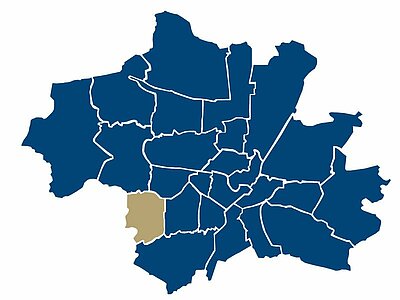
According to the state capital of Munich, Hadern forms the south-western edge of the city and is located west of Fürstenried Straße, between Senftenauerstraße to the north and the A95 to the south. This location explains much of the district's character: Hadern has a more airy and residential feel than many neighborhoods closer to the city center, but remains well connected via public transport and major road axes.
This is a relevant location advantage, especially for people who want to live in a quieter area of Munich but not too far away from everyday city life.
The sub-areas of Großhadern, Kleinhadern, Blumenau and Neuhadern are particularly important for the classification of Hadern. In addition, there are the neighboring western and south-western residential areas of Munich, which help to shape the character of the district.
The decisive factor for prospective residents is that Hadern is not a uniform district, but consists of several areas, each with its own residential character. Anyone looking for a home here should therefore not only consider Hadern as a whole, but also take into account the differences between village-like locations, loose residential development and larger residential complexes.
Hadern is strongly shaped by the Großhadern Hospital, medical facilities, and the university and research community. The connection to biology, chemistry, medicine, and the natural and life sciences also plays an important role in the Großhadern and Martinsried area. For residents, this means that Hadern is not only a quiet neighborhood but also one with a clear focus on knowledge, healthcare, and employment opportunities in the background.
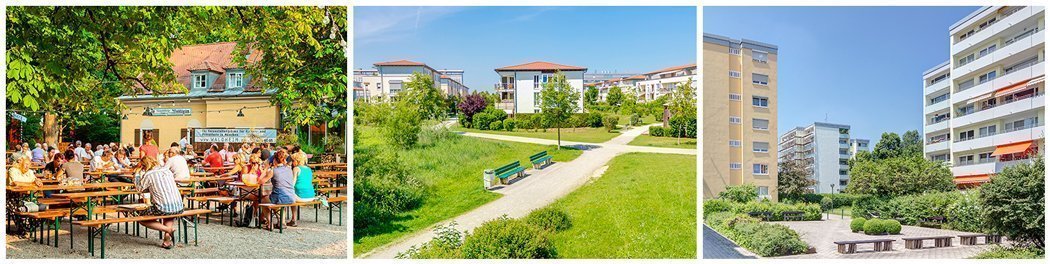
At the same time, Hadern is a much more diverse residential area than its association with the hospital might initially suggest. In many areas, low-density single-family homes define the cityscape. Added to this are larger postwar housing complexes in Blumenau and Neuhadern, as well as historic village structures in Großhadern around Heiglhofstraße and Würmtalstraße.
It is precisely this mix that makes Hadern attractive to those looking for housing: Hadern offers quiet residential neighborhoods, family-friendly areas, and a variety of building types—from single-family homes to established village structures and larger residential complexes.
This neighborhood is ideal, for example, for the following people:
Families looking for a quieter place to live
People who work in the hospital or university environment
Expats and project workers who need good subway access
Prospective homebuyers looking for stable, long-term neighborhoods
Commuters who want to combine a suburban location with convenience for daily life
| To the center (Marienplatz) | To the central station | To the airport |
|---|---|---|
| 9,6 km | 8,4 km | 45,9 km |


Hadern offers good local amenities for daily needs with stores and smaller stores in the district. The Haderner Stern in particular is an important point of orientation: the subway connection, shopping facilities, city library and other facilities all come together here.
The gastronomy in Hadern tends to be close to home and uncomplicated. Restaurants and cafés blend into the everyday life of the district and offer short distances for meetings in the neighborhood. If you are looking for anapartment in Hadern, you will not find a noisy nightlife district, but a quiet residential environment with suitable offers for everyday life.
A major advantage of Hadern is its high recreational value due to its proximity to green spaces in the southwest. Walks, sport and recreation can be easily integrated into everyday life; there are also sports facilities in the district. This makes Hadern particularly suitable for people who are looking for a green residential area in Munich and at the same time want to remain well connected via the U6 underground line.