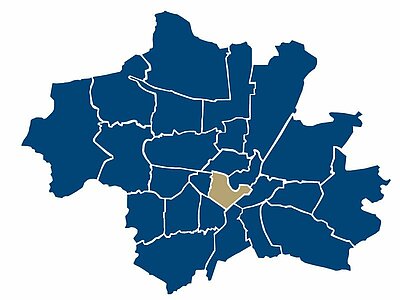
The Gärtnerplatzviertel is located in the Ludwigsvorstadt-Isarvorstadt district and is one of Munich’s inner-city neighborhoods that is particularly close to the Altstadt. It is characterized by its location between Sendlinger Tor, Fraunhoferstraße, the Isar River, and the neighboring Glockenbachviertel. Residents here benefit from a very central location within the city while also enjoying a neighborhood that feels distinctly its own in everyday life.
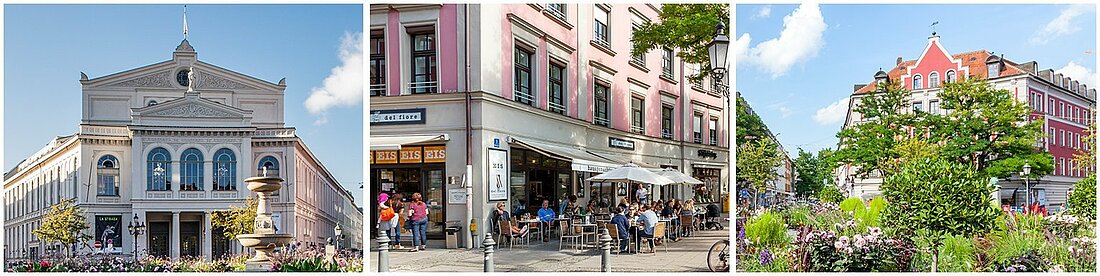
Gärtnerplatz forms the identity-defining center of the neighborhood. The official city portal describes it as a roundabout that was built as early as 1860 and is now an important gathering place in the neighborhood. This is precisely what gives the area its special quality of life: The Gärtnerplatzviertel is compact, urban, and easy to navigate —you quickly get a feel for how the neighborhood works and where its focal points lie.
The neighborhoods directly adjacent to it are primarily Isarvorstadt and the Glockenbachviertel. To the northwest, there’s a smooth transition to the Altstadt and the area around Sendlinger Tor; to the southwest, the neighborhood opens up toward Ludwigsvorstadt. This is relevant for prospective residents because it means the Gärtnerplatzviertel isn’t isolated but can be seen as part of one of Munich’s most sought-after contiguous downtown areas.
So anyone looking to rent or buy an apartment here isn’t just choosing the square itself, but also the convenience of being close to several vibrant neighborhoods: the Altstadt for errands and trips to the Zentrum, the Isar River for leisure and exercise, and the Glockenbachviertel for additional dining and cultural offerings.
The Gärtnerplatzviertel is one of Munich’s residential areas that makes an impression through its cityscape and atmosphere. The City of Munich classifies the neighborhood as a Gründerzeit-style district of apartment buildings and commercial properties, featuring a large stock of older buildings that remain largely well-maintained to this day. It is precisely this blend of historic architecture, a dense urban fabric, and a vibrant ground-floor retail scene that makes living here so appealing. Rather than wide avenues and open spaces, everyday life here is defined by intimate streets, historic building facades, and corners lined with cafés and unique shops.
Typical of the neighborhood are apartments with unique layouts, the charm of historic buildings, and a true downtown location. The Gärtnerplatzviertel is particularly well-suited for people who value short distances and actively engage with their living environment: working professionals with jobs in the city center, expats, couples, singles, creative types, and anyone seeking an urban lifestyle not just on weekends but in their everyday lives. The location can also be attractive for families if their priorities include living centrally, short commutes, and a well-established neighborhood.
Typical resident groups in the neighborhood include, for example:
| To the center (Marienplatz) | To the central station | To the airport |
|---|---|---|
| 0,9 km | 2,2 km | 38,5 km |


The Gärtnerplatzviertel doesn’t stand out for any single large-scale establishment, but rather for its many smaller, unique shops and the convenience of having everything you need for daily life close at hand. This small-scale structure fits well with the character of the neighborhood and reinforces the feeling of living in a well-established inner-city neighborhood rather than in a purely functional downtown location.
Around Gärtnerplatz and in the surrounding streets, the dining scene is dense and diverse. From a residential perspective, it’s not so much the individual hotspots that matter as the overall structure: you live in a neighborhood where cafés, bars, restaurants, and smaller gathering spots are a natural part of the streetscape. This makes the location particularly attractive for people who want to actively engage with their neighborhood.
A major advantage of living here is the proximity to the Isar River and its floodplains. The Reichenbach Bridge is within easy reach, and the riverbank offers attractive opportunities for walking, running, and biking.
This provides a direct contrast to the very urban neighborhood: You live in a dense, central area, yet at the same time have access to a wide range of recreational opportunities just a few minutes away.