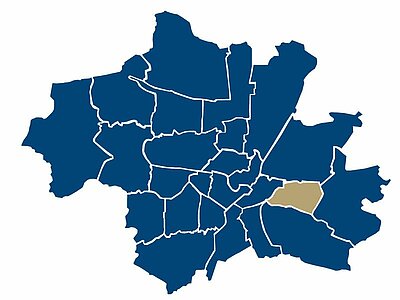
Berg am Laim is nestled between Haidhausen to the west, Trudering to the east, Bogenhausen to the north and Ramersdorf to the south. Despite its comparatively small area, the district is very well anchored in Munich's urban space. One of the great advantages is that Berg am Laim does not feel like a purely peripheral location: The district is close enough to the city center to allow for short commutes, while also offering an independent living environment with a mature structure.
The name of the district goes back to "ad Perke auf dem Laimb" and refers to the natural characteristics of the area as a loam hill or loess loam tongue. This historical character is not only interesting from a linguistic point of view, but also explains why Berg am Laim was an important location for brickworks for a long time. It is precisely this history that has given rise to a district that today combines living, working and new neighborhood development.
Berg am Laim borders on several very different districts, each with its own atmosphere. To the west is Haidhausen with its urban proximity to Ostbahnhof, to the north is Bogenhausen, to the east is Trudering and to the south is Ramersdorf. Anyone looking to rent or buy an apartment in Berg am Laim therefore benefits not only from the district itself, but also from the short distances to neighboring districts with very different residential and leisure qualities.
Berg am Laim combines tradition and modernity in a particularly visible way - extra reference to the historic center around St. Michael as well as newer residential developments, apartment buildings and individual commercial areas. It is precisely this contrast that is exciting from a residential perspective: Berg am Laim is neither purely a district of old buildings nor purely a new development area, but a district with a variety of residential styles and a correspondingly diverse search profile.
There are also newer neighborhood developments. Baumkirchen Mitte, which was built on a former railroad site on Baumkirchner Strasse, is particularly distinctive. Around 560 apartments and around 650 jobs have been created there. Together with other developments in the surrounding area and the proximity to the Werksviertel, it is clear that Berg am Laim has developed noticeably in recent years without completely losing its established core.
Typical resident groups in the district are, for example
This classification results from the central location in the east of Munich, the good transport connections, the different types of housing and the mix of historic, mature and newly developed areas.
| To the center (Marienplatz) | To the central station | To the airport |
|---|---|---|
| 6,3 km | 8,3 km | 38,0 km |


In everyday life, Berg am Laim benefits from short distances to local amenities and the district center. The Green Market and the adjacent Behrpark were expressly developed by the City of Munich as a place with a high quality of stay. There are also other stores and services in the district as well as easy access to neighboring centers. It is precisely this mix that makes Berg am Laim pleasantly uncomplicated in everyday life.
Berg am Laim does not primarily live from a classic nightlife district, but rather from a mixture of local offerings, local amenities and good accessibility to larger cultural and gastronomic locations in the east of Munich. The nearby Werksviertel in particular adds a wide range of cultural, gastronomic, leisure and sports facilities to the area. As a result, Berg am Laim remains residential and suitable for everyday life without having to forego urban amenities in the immediate vicinity.
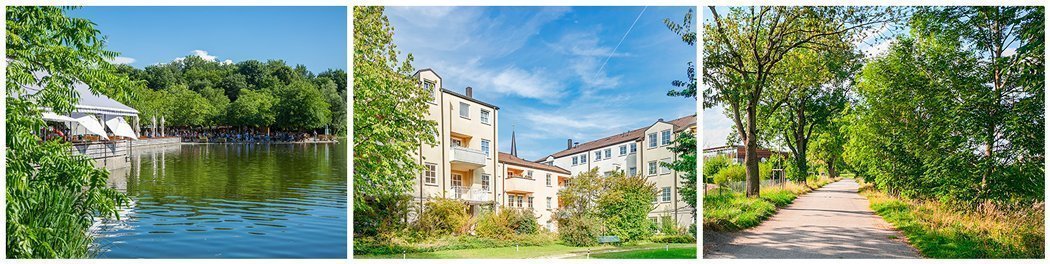
Berg am Laim has several important green spaces - specifically named: Piusplatz, Behrpark and Michaelianger. In addition, the Echardinger green strip, together with Michaelianger and Piusplatz, forms an important green link in the east of Munich. People who live here therefore not only have transport links, but also open spaces close to their homes for recreation and exercise.