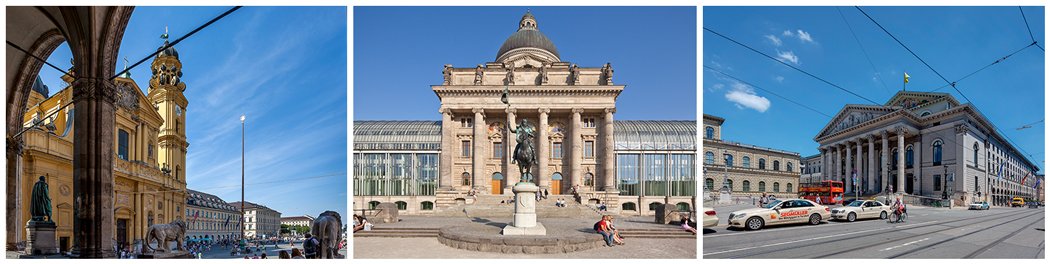
The Altstadt’s greatest strength is its uncompromising role as the city center. The very heart of Munich’s city life lies around Marienplatz; from here, short paths lead in all directions—to the pedestrian zone, the Viktualienmarkt, the Residenz, the Isartor, and toward Odeonsplatz.
To this day, official city and tourism information describes Marienplatz as the Zentrum of Munich and the starting point for many of the city’s most important streets, squares, and shopping districts.
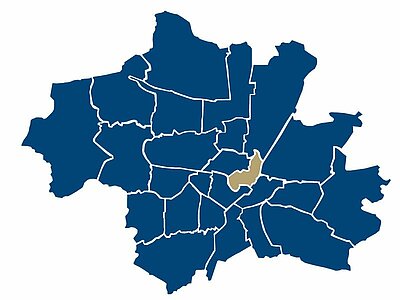
When classifying it as a residential area, it is important not to view the Altstadt in isolation. Directly adjacent are, above all, Lehel, the areas toward Maxvorstadt, and—to the south and west—the transitions to other inner-city neighborhoods. This is precisely why the Altstadt functions not only as a destination but also as a starting point: many of Munich’s central neighborhoods are accessible on foot, by bike, or within a few stops.
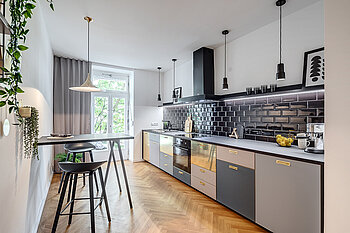
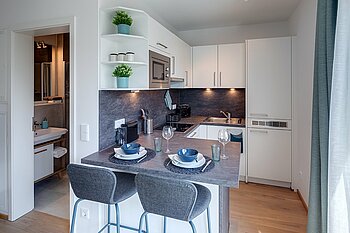
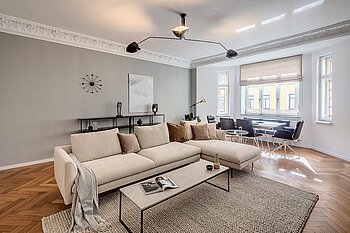
Living in the Altstadt means, above all, a prime central location with a very limited supply of housing. The area is one of Munich’s most exclusive residential addresses and is accordingly in high demand. The housing mix ranges from historic buildings and classic city apartments to modernized downtown apartments in prestigious locations.
Unlike many other Munich neighborhoods, the classic sense of community is less prominent here. Instead, the area is defined by its combination of a central location, architecture, prestige, and short distances to everything.
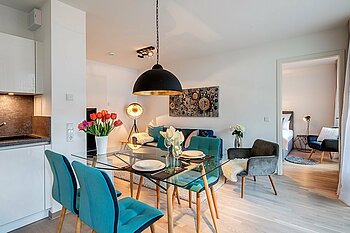
The Altstadt is particularly well-suited for people who want to live in an urban, high-quality setting with direct access to culture, dining, and business districts. It is especially appealing to working professionals, international specialists, urban couples, second-home owners, and buyers with a clear preference for this location. The Altstadt also offers an excellent environment for high-quality temporary housing.
For families, the Altstadt is less of a classic, quiet residential neighborhood. Instead, it offers excellent amenities, short distances, and maximum convenience for daily life in the Zentrum of the city.
Living in the Altstadt means, above all, maximum centrality with a very limited supply of housing. The location is among Munich’s most exclusive residential addresses and is accordingly in high demand. The housing mix ranges from historic buildings and classic city apartments to modernized downtown apartments in prestigious locations.
Unlike many other Munich neighborhoods, the classic sense of community is less prominent here. Instead, the area is defined by a combination of its central location, architecture, prestige, and short distances to everything.
The Altstadt is particularly well-suited for people who want to live in an urban, high-end setting with direct access to culture, dining, and business districts. It is especially appealing to professionals, international specialists, urban couples, second-home owners, and buyers with a clear preference for this location. The Altstadt also offers an excellent environment for high-quality temporary housing.
This residential area is of interest, for example, to the following people:
| To the central station | To the airport |
|---|---|
| 2,0 km | 38,0 km |


Kaufingerstraße and Neuhauser Straße make up Munich’s central pedestrian zone. Official sources describe them as one of Germany’s first car-free shopping districts and as highly frequented shopping streets featuring a wide variety of traditional stores, chain stores, small shops, arcades, and restaurants. For those who live in the Altstadt, this corridor serves as an integral part of their daily infrastructure right in their immediate vicinity.
Culinary-wise, the Viktualienmarkt is the heart of the Altstadt. Official city information describes it as a market in the heart of the Altstadt that evolved from a farmers’ market and today offers everything from Bavarian to exotic goods. This market atmosphere is complemented by numerous restaurants, cafés, and traditional venues, including the Hofbräuhaus am Platzl, which is considered the epitome of Bavarian beer culture.
Despite its urban density, the Altstadt also offers valuable recreational spaces. The Hofgarten borders directly on the northern part of the Altstadt, and it’s just a short walk to the English Garden. In addition, the Marienhof and easy access to the Isar riverbanks provide further recreational benefits.
For residents, this provides an important balance: The Altstadt is bustling, central, and lively, yet at the same time offers opportunities to quickly get out into nature as part of daily life.