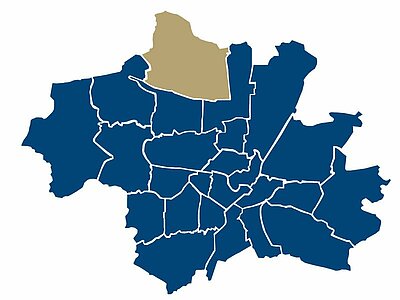
Hasenbergl is located in City District 24, Feldmoching-Hasenbergl, Munich’s second-largest city district in terms of area. The City of Munich describes the district as the northernmost part of Munich, bounded by Schleißheimer Straße, Dachauer Straße, the DB Nordring, and the city limits. This is important from a residential perspective because it clearly positions Hasenbergl as a suburban area with plenty of open space —rather than a dense inner-city neighborhood.
Within the district, Hasenbergl stands out due to its unique settlement history and its location in an open space setting. The neighborhood revitalization project and the Cultural History Trail explicitly describe the neighborhood as a low-density area surrounded by greenery with good transportation connections; the surrounding area includes Feldmoching Anger, Korbinianiholz, and the Panzerwiese/Hartelholz nature reserve. From a residential perspective, it is precisely this quality of location that is one of the neighborhood’s greatest advantages.
Hasenbergl is an attractive residential area primarily because it combines a large housing development, a family-oriented atmosphere, and open space on the city’s outskirts. The Culture and History Trail describes the large housing development, built starting in 1960, as a neighborhood planned with green spaces throughout; 5,377 rental apartments, 168 condominiums, and 48 single-family homes were built to house approximately 17,400 people. This makes it clear that Hasenbergl was conceived from the outset as a distinct residential district—not merely as a temporary addition.
Added to this is the second development phase, Hasenbergl-Süd, which was built between 1965 and 1968 west of Eberwurzer Straße and Rainfarnstraße. There, another 1,500 rental apartments and 236 condominiums were built for about 7,000 people; a high-rise building still defines the skyline of this subarea today. From a residential perspective, this means that Hasenbergl is not a uniform neighborhood but consists of several distinctly different residential areas.
Social and infrastructural development is also important. The City of Munich emphasizes that families with children continue to be overrepresented in the Hasenbergl district and that the neighborhood has improved significantly in recent years—in part due to the U-Bahn and S-Bahn, public and social facilities, and the 2411 Cultural Center as a new hub. It is precisely this development that is central to a current description of the residential area.
| To the center (Marienplatz) | To the central station | To the airport |
|---|---|---|
| 13,1 km | 12,6 km | 31,9 km |


A major advantage of Hasenbergl is the balance it strikes between peaceful living and practical everyday life. The neighborhood isn’t glamorous, but it offers many of the things that matter in daily life: the subway, social amenities, open spaces, and a relaxed residential area away from the hustle and bustle of the immediate city center. It is precisely this mix that makes Hasenbergl attractive to people with a variety of housing needs.
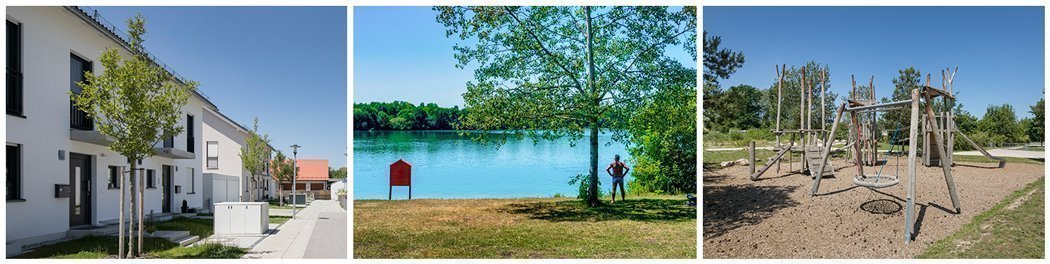
The greatest recreational value lies in the green spaces and open areas of the neighborhood and its surroundings. The neighborhood revitalization plan explicitly cites the proximity to nature, the quiet residential environment, and easy access to Feldmoching Lake, Lerchenau Lake, and other natural areas as key qualities of the neighborhood. This makes Hasenbergl significantly richer in open space in everyday life than many more densely built-up neighborhoods.
Hasenbergl continues to have a strong family-oriented character. The city points out that families with children remain overrepresented in this part of the district. Together with playgrounds, green spaces, and social infrastructure, this explains why the neighborhood is now significantly more appealing to families than its old image would suggest.