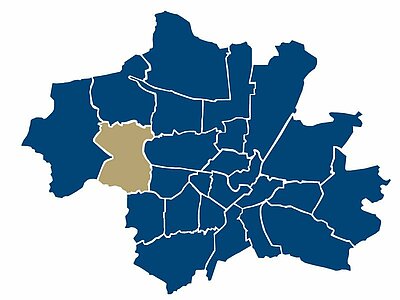
Pasing is located in the western part of Munich and, together with Obermenzing, is now part of City District 21, Pasing-Obermenzing. However, it is Pasing itself that is key to its reputation as a residential area: a neighborhood with its own Zentrum, a wide range of everyday amenities, and a clear sense of location between the train station, Marienplatz, the Würm River, and the city park. It is precisely this mix that makes the neighborhood attractive to many people looking for a place to live: you don’t just live “in the west,” but in a neighborhood with its own center and a clearly recognizable identity.
The central focal point is the Munich-Pasing train station, from which the main shopping and service corridors extend toward Marienplatz and Gleichmannstraße. To the south and west of this, Pasing becomes noticeably more residential and greener, especially toward the Würm River and Pasing City Park. Added to this are historic residential areas in the villa colonies, which continue to shape an important part of the cityscape to this day.
Pasing is particularly interesting in terms of its geographical context because it borders several very different neighboring areas. To the east, there are connections to Laim and Nymphenburg; to the north, the urban landscape transitions toward Obermenzing; to the west, it borders Aubing; and to the south, there are connections toward Hadern. A comparison of Pasing with these neighboring districts reveals differences in housing types, transportation routes, and lifestyle.
Pasing differs from many other residential areas in Munich in that it is not only a residential neighborhood but also a well-established Zentrum for western Munich. This makes everyday life here convenient: shopping, public transportation, cultural offerings, and amenities are all close together, while the city park, the Würm River, and quieter residential streets provide significantly more relaxed areas. As a result, those who live in Pasing often benefit from short distances and a neighborhood that feels urban without being exclusively hectic.
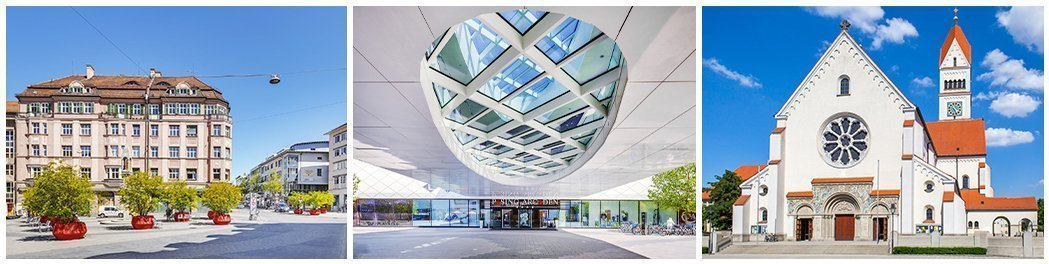
The cityscape is also comparatively diverse. Around Pasing’s Marienplatz and in the Villa Colonies I and II, there are beautiful examples of Wilhelminian-style architecture; these are complemented by postwar multi-story apartment buildings as well as single- and two-family homes. Between the train station and Offenbachstraße, the Pasing Arcaden add a distinctly urban touch and reinforce Pasing’s character as an independent neighborhood center. It is precisely this mix that appeals to prospective buyers and renters: historic residential areas, infrastructure suited to everyday life, and diverse micro-neighborhoods within a compact area.
Pasing is particularly well-suited for:
| To the center (Marienplatz) | To the central station | To the airport |
|---|---|---|
| 14,6 km | 12,2 km | 45,4 km |


Local amenities in Pasing are particularly well-developed around Marienplatz, Gleichmannstraße, and the train station. In addition, there is the Pasing Arcaden, which features nearly 150 retail and dining establishments, as well as service, office, and residential spaces. This selection is complemented by the Pasing Viktualienmarkt, which preserves the neighborhood’s local, everyday character.
With the Pasinger Fabrik, the neighborhood boasts an important cultural and community center featuring theater, concerts, exhibitions, dining, and social programs. This reinforces Pasing’s appeal as a residential area for people who want to live not only in a functional setting but also in a neighborhood with a certain cultural offering right on their doorstep.
Pasing City Park and the Würm River give the neighborhood a green side that’s immediately noticeable in everyday life. The park covers about 20 hectares and is roughly 1.5 kilometers long, making it ideal for walks, jogging, playgrounds, or quick breaks throughout the day. From a residential perspective, this is a real advantage, because the green space here isn’t just a backdrop—it’s open space that can be used right away.