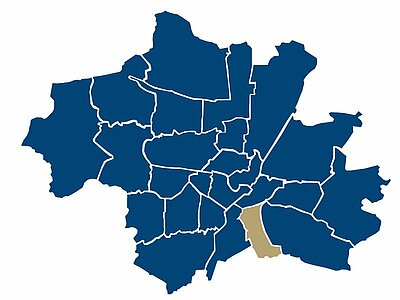

Fasangarten is part of the district 17 Obergiesing-Fasangarten and forms the south-eastern outskirts of the city. The city of Munich describes the district as a narrow strip between the south-eastern section of the Mittlerer Ring and the S-Bahn line S3 to Holzkirchen, which includes areas closer to the city center as well as the south-eastern outskirts of the city with the Fasangarten. This location is particularly interesting from a residential perspective: Fasangarten is clearly located within Munich, but its location next to the forest and its small-scale structure make it much quieter than many central districts.
One major advantage of the location is its immediate proximity to Perlach Forest. As a result, Fasangarten combines proximity to the city and nature in a way that is comparatively rare in Munich.
Fasangarten is closely connected to several neighboring residential areas. Its proximity to Harlaching, Unterhaching and Giesing creates an environment that is quiet and independent, but at the same time well integrated into the south of Munich. As Fasangarten is part of the Obergiesing-Fasangarten district, those looking for a home benefit from a location that combines residential tranquillity with good urban connections.
Fasangarten is primarily a quiet residential area with a small housing estate character - single-family houses and small housing estates with green spaces. The residential pattern is therefore much smaller than in many other locations in the south-east of Munich. This is what makes the district interesting for people who want to live in Munich in a more secluded and residential manner.
Historically, this character can be explained by the district's origins. The City of Munich's KulturGeschichtsPfad (CulturalHistoryTrail) states that a wild settlement developed in the 1920s in the previously wooded area and that Fasangarten was incorporated into Munich on October 1, 1937. The district was already considered independent in the 1920s before it became part of Munich in 1937. This is precisely what gives it the image of a residential district that has grown rather than being strictly planned, which is still noticeable today.
Typical resident groups in the district are, for example
This classification results from the small-scale residential structure, the proximity to the forest and the S-Bahn connection to the city center.
| To the center (Marienplatz) | To the central station | To the airport |
|---|---|---|
| 6,0 km | 8,0 km | 42,0 km |


Fasangarten offers functional local amenities for everyday needs that fit in well with the quiet and residential character of the neighborhood. The supply is less metropolitan and more practically oriented towards everyday life. This is precisely what strengthens the location's suitability for everyday use, as important distances remain short and the residential environment retains its down-to-earth, pleasant structure.
In terms of gastronomy, Fasangarten also remains rather residential and reserved. Individual restaurants, cafés and smaller eateries complement everyday life without giving the district the character of a distinct nightlife district. This fits in well with the overall image of the district: quiet, practical and geared towards a pleasant quality of living.
A major advantage of Fasangarten is its direct proximity to Perlach Forest. There are also many green spaces and other leisure activities in the surrounding area. The district is therefore particularly suitable for walks, cycling and everyday exercise.