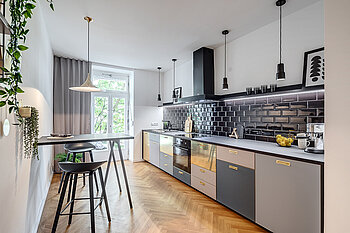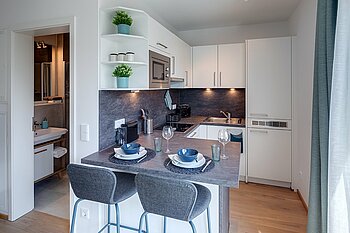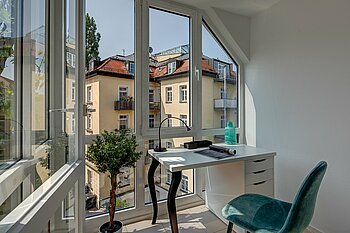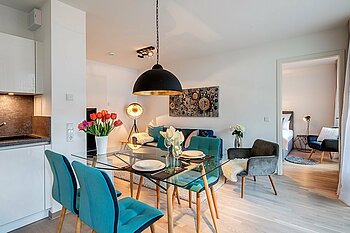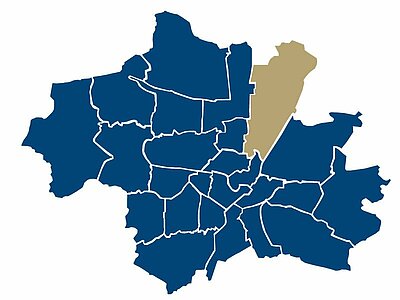
The Studentenstadt is located in Freimann, in the northern part of Munich. The residential campus is part of the Schwabing-Freimann district, whose eastern edge—according to the KulturGeschichtsPfad—stretches like a green ribbon from the English Garden to the Isar floodplains. This is important from a residential perspective because, despite its compact structure, Studentenstadt feels significantly more open and spacious than many other student housing areas.
Geographically, the location can be easily explained using a few key landmarks: the Studentenstadt subway station, Ungererstraße, Föhringer Ring, the northern part of the English Garden, and the neighboring residential areas in Freimann, Kieferngarten, and Alte Heide. It is precisely these landmarks that are more useful to those searching for housing than a purely administrative classification, because Studentenstadt is understood primarily through the quality of its location and its campus-like character.
Surrounding Studentenstadt are several residential areas— Freimann, Kieferngarten, and Alte Heide —each with its own distinct character. While Studentenstadt is strongly characterized by student housing, the neighboring areas have a somewhat more traditional and residential feel.
It is precisely this proximity to different types of housing that makes the area interesting. This allows residents to choose between student campus life and a quieter residential environment without having to sacrifice good transportation connections and short distances in northern Munich.
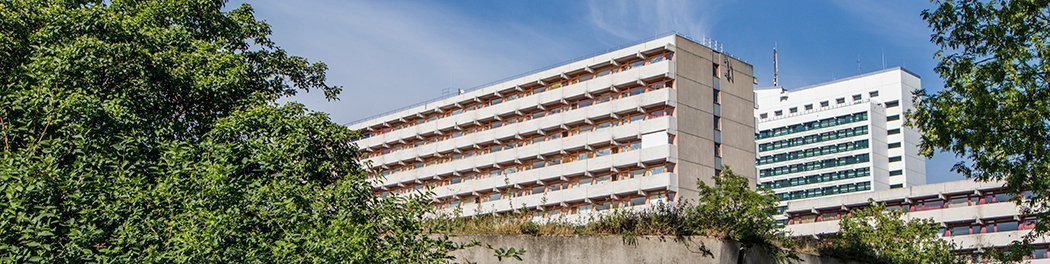
The Studentenstadt is particularly interesting as a residential area because it is not a typical postwar housing development, but rather a deliberately planned residential campus. According to the KulturGeschichtsPfad, construction began in 1961; initially, based on Ernst Maria Lang’s design, the complex consisted of only two high-rises and several atrium buildings. In the 1970s, it was expanded to include the high-rises facing Ungererstraße and is now the largest residential campus in Germany.
The Studierendenwerk also clearly describes the complex in terms of its unique internal structure: The so-called Altstadt (Old Town) was built from 1961 to 1968 and is more community-oriented, while the Neustadt (New Town ), built from 1970 to 1977, consists primarily of high-rises and individual apartments. According to the Studierendenwerk, both areas are idyllically situated in a green setting. It is precisely this blend of community, compactness, and open space that continues to make the Studentenstadt special to this day.
Studentenstadt primarily appeals to students, young professionals, small households, and people looking for temporary housing close to the university.
| To the center (Marienplatz) | To the central station | To the airport |
|---|---|---|
| 7,0 km | 7,8 km | 29,1 km |


Studentenstadt has an unusually vibrant community life of its own. Since 1989, the Studentenstadt München association has been documenting the large student theater and cultural festival held on the grounds through the StuStaCulum; in addition, there are sports and club activities. This makes the location particularly attractive for people who don’t just want to live there, but who want to be part of a close-knit community.
Sports are clearly a defining feature of Studentenstadt. The Culture and History Trail mentions the town’s own rugby team; the City of Munich lists activities such as soccer, rugby, tennis, and volleyball offered by SV Studentenstadt Freimann e.V. For such a compact residential area, this is a remarkably robust recreational offering.
When it comes to recreation and exercise, this Studentenstadt benefits greatly from its surroundings. In addition to the English Garden, Feringa Lake and the Aumeister are also easily accessible destinations for leisure activities. This means that nature here is not just a bonus, but an integral part of the quality of life.