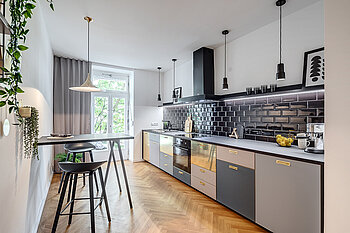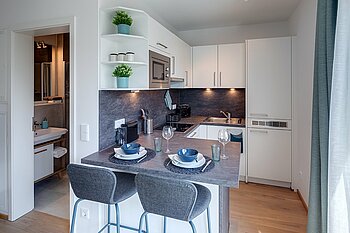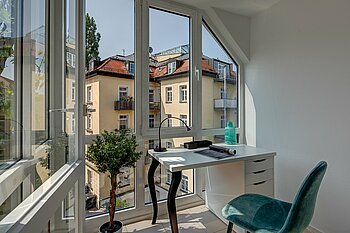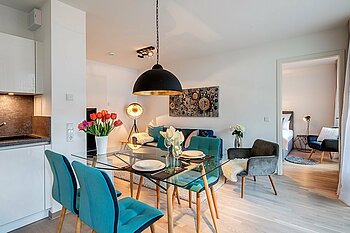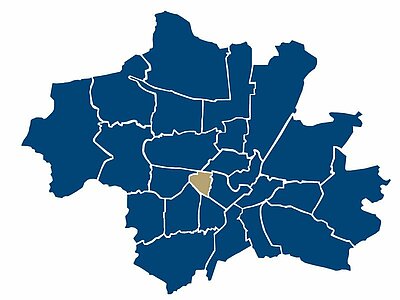

According to the City of Munich, the 8th district, Schwanthalerhöhe, forms the western edge of the city center and is bounded by the Hauptbahnhof–Pasing and Hauptbahnhof–Ostbahnhof rail lines. Schwanthalerhöhe is located on the Isar lowland terrace; its development is closely linked to industrialization, which gave rise to highly dense, Gründerzeit-era working-class neighborhoods. This is important from a residential perspective because the district still retains a very distinct urban structure to this day.
At the same time, Schwanthalerhöhe is not homogeneous. The city explicitly distinguishes between the Westend, west of Ganghoferstraße, with cooperative housing developments dating from around 1900, and the eastern part of the district, which has undergone extensive redevelopment since the 1970s. To the south of this, on the former fairgrounds, the new Theresienhöhe neighborhood was later developed. For those looking for a place to live, this internal structure is particularly useful.
Surrounding Schwanthalerhöhe are several urban areas— Westend, Theresienhöhe, Ludwigsvorstadt, Neuhausen, and Sendling —each with its own distinct character. The location combines established residential neighborhoods with more modern inner-city structures and short distances to the Zentrum.
It is precisely this position—between a traditional neighborhood, new urban development, and a western downtown location —that defines the unique residential character of Schwanthalerhöhe. This creates a variety of options for daily life, living, and mobility within a relatively compact area.
Schwanthalerhöhe is a particularly interesting residential neighborhood because it uniquely blends tradition with urban transformation. The neighborhood evolved from a classic 19th-century working-class district and has undergone extensive renovation and revitalization over the decades. Despite these changes, a distinct neighborhood character has been preserved. It is precisely this blend of history, established structure, and modern urban development that shapes the living experience today.
Typical features of Schwanthalerhöhe include older buildings, renovated residential buildings, and newer residential and office structures. This creates a varied cityscape that feels urban without taking on the character of a neighborhood consisting solely of new construction. Its central location, short distances, and intimate neighborhood life make the district particularly attractive to people seeking a vibrant living environment with established structures.
Schwanthalerhöhe is well-suited, among others, for professionals with ties to the city center, couples and singles, as well as students and younger households. The neighborhood also offers ideal conditions for people who wish to live in a furnished, temporary residence in a central location. Key factors include excellent accessibility, a diverse neighborhood, and proximity to downtown Munich.
| To the center (Marienplatz) | To the central station | To the airport |
|---|---|---|
| 4,3 km | 2,2 km | 40,3 km |


Schwanthalerhöhe is well-equipped to meet everyday needs. Numerous stores and the Forum Schwanthalerhöhe cover many of the daily shopping needs. Added to this is the neighborhood’s compact layout, which makes for short distances. This combination makes the location particularly convenient for everyday life.
The culinary diversity of Schwanthalerhöhe is spread across various parts of the neighborhood. Cafés, bars, and restaurants are well integrated into the neighborhood’s established fabric, without life being concentrated exclusively along a single nightlife strip. As a result, despite its diverse offerings, the neighborhood remains clearly recognizable as a residential area with an urban character.
The most important green space in Schwanthalerhöhe is Bavariapark. With its play areas and open spaces, it offers a place for relaxation, exercise, and spending time outdoors. Especially in a densely built-up neighborhood, the park provides an important counterbalance to the urban environment and noticeably contributes to the quality of life and the enjoyment of the area.