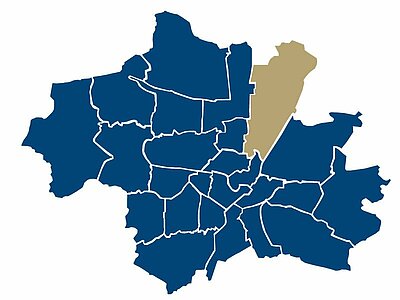
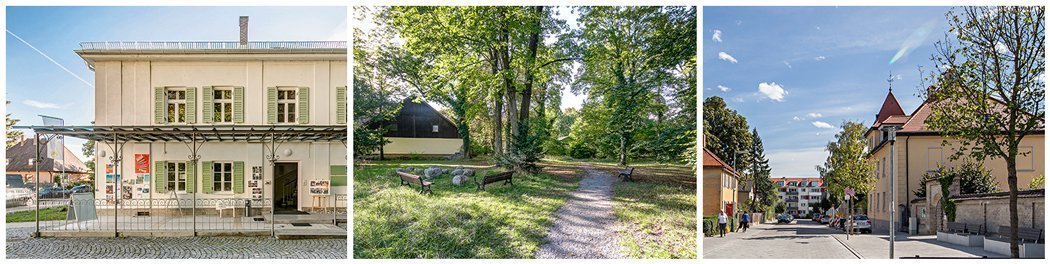
Freimann is located in the northern part of the 12 Schwabing-Freimann district. The city of Munich describes the district as a wedge-shaped area between the 11th and 4th districts in the west and the English Garden and Isar in the east, stretching from the city limits to the Siegestor. Within this large district, Freimann forms the more north-facing part with village-like, newly built and commercial areas. This is precisely what makes the location interesting from a residential perspective: Freimann is not uniform, but offers different residential profiles within a well-connected Munich district.
From a residential perspective in particular, the combination of proximity to the city and functional everyday life is a clear advantage. Freimann is not just an excursion or villa suburb, but a mature district with subway connections, cultural offerings, commercial areas, leisure facilities and older residential areas. Its proximity to the U6 underground line, the A9 motorway, cultural facilities and recreational areas such as Fröttmaning Heide makes Freimann a location that combines everyday life, mobility and quality of life comparatively well.
Freimann borders on several very different neighborhoods. The links to Schwabing, Alte Heide, Kieferngarten, Fröttmaning and Milbertshofen are particularly important in everyday life - Kieferngarten, Parkstadt Schwabing and Milbertshofen are other nearby alternatives. Anyone looking to rent or buy an apartment in Freimann therefore benefits not only from the district itself, but also from short distances to neighboring residential and working areas, each with their own character.
Freimann is not a homogeneous neighborhood. The City of Munich explicitly describes it as an area characterized by village-like and newly built residential developments, as well as commercial areas. It is precisely this mix that is crucial to the residential landscape: In the old center around St. Nikolaus, Freimann feels organic and almost village-like, while other parts feature 20th-century housing developments, new neighborhoods, and large-scale commercial uses. This makes Freimann a particularly diverse place to live.
Freimann has evolved from a residential area that was once rather sparsely developed into a district with a diverse housing structure. Over time, alongside older, established residential areas, housing developments for families, rental and condominium complexes, and newer residential areas with complementary commercial spaces and parks have emerged. This is relevant for prospective renters and homebuyers because Freimann combines various types of housing and meets a wide range of search criteria.
Typical resident groups in the neighborhood include, for example:
This classification is based on the neighborhood’s residential structure, cultural and recreational facilities, U6 subway access, and the mix of residential, commercial, and service offerings in the neighborhood.
| To the center (Marienplatz) | To the central station | To the airport |
|---|---|---|
| 10,1 km | 10,6 km | 29,1 km |


Freimann is solidly positioned in everyday life - stores for daily needs right in the district. In addition, according to the City of Munich, the western Freimann commercial area with the Europark / Euro-Industriepark is predominantly commercial and retail. As a result, Freimann remains functional and well-supplied in everyday life without looking like a classic shopping district.
Freimann also offers gastronomic structures suitable for everyday use. The cultural and gastronomic environment is complemented by places such as the Metropoltheater and the Mohr-Villa, which make the district livelier without overloading it
Freimann also offers more than just a purely urban location in the leisure sector. With the Fröttmaning Heath as a nearby recreational area, the Fröttmaning Hill with its sweeping views and other sports and leisure areas in the northern surroundings, the district combines everyday urban life with easily accessible nature and outdoor exercise. This is an important advantage, especially from a residential perspective, because everyday life, recreation and open countryside can be combined comparatively well here.