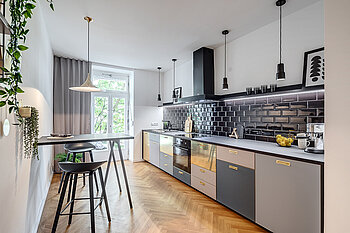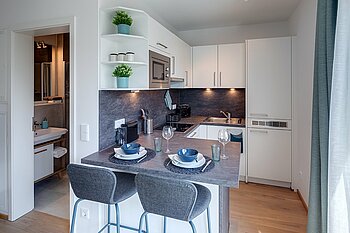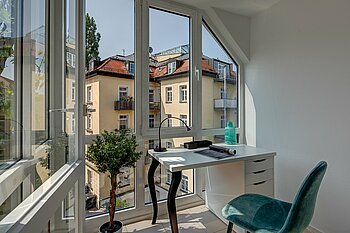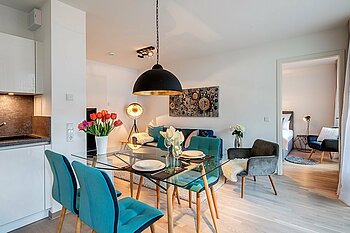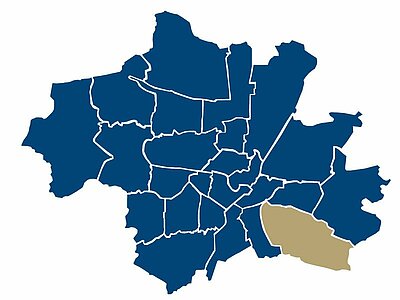
Ramersdorf is located in southeastern Munich and is part of City District 16, Ramersdorf-Perlach, which, according to the city, stretches from the outskirts of downtown to the city limits. Within this large district, Ramersdorf is the historically older sub-district. The city describes the former village center around Maria Ramersdorf as now being separated from the surrounding residential areas by the Mittlerer Ring and the access road to the Salzburg highway. This is important from a residential perspective because it explains the sharp division between the historic core and the modern transportation infrastructure.
At the same time, Ramersdorf is clearly divided in terms of residential layout. According to the city, single-family homes predominate in the southern part, while to the north the landscape transitions to denser multi-story development; particularly around Rosenheimer Straße, there are numerous cooperative housing complexes. It is precisely this diversity that makes the neighborhood interesting from a prospective resident’s perspective, as Ramersdorf offers more than just one type of housing.
Surrounding Ramersdorf are several neighborhoods— Perlach, Neuperlach, Giesing, and Berg am Laim —that differ, in some cases significantly, in terms of residential structure, transportation connections, and price levels. While some areas have a more urban character, others offer a quieter living environment or larger new-construction developments. This makes it worthwhile to take a closer look at the specific characteristics of the neighboring neighborhoods.
Ramersdorf is an attractive residential area primarily because it combines historic architecture, new housing developments, and good accessibility. The city describes it as a neighborhood that has evolved over time, developing from an old village into an urban residential area. The district committee points out that Ramersdorf had only about 1,500 residents in 1918 and then grew rapidly with the development along Rosenheimer Straße; by 1939, the population had already reached about 8,500. This illustrates just how strongly today’s neighborhood has been shaped by 20th-century housing development.
Particularly important from a residential perspective is the mix of quieter residential streets in the south and denser areas in the north. This is complemented by historically significant subareas such as the Ramersdorf model housing estate, which, according to the KulturGeschichtsPfad, was built as part of the 1934 German Housing Exhibition. For those looking for a place to live, this means that Ramersdorf offers both classic, more low-density residential areas and functional, city-adjacent areas with a higher concentration of multi-story apartment buildings.
From a residential perspective, typical target groups for Ramersdorf include working professionals seeking strong subway connections, couples and singles who want to live close to downtown but not right in the Zentrum, families who prefer quieter residential areas, and those interested in temporary housing when accessibility and practicality for daily life are the top priorities. This classification is an editorial assessment based on housing structure, transportation, and location profile.
| To the center (Marienplatz) | To the central station | To the airport |
|---|---|---|
| 6,5 km | 9,3 km | 39,1 km |


Ramersdorf is convenient and well-suited for everyday life. The mix of residential areas, shopping options, and good public transportation connections ensures short commutes and makes daily life easier to manage. The neighborhood offers ideal conditions, especially for people who value accessibility and a well-functioning infrastructure.
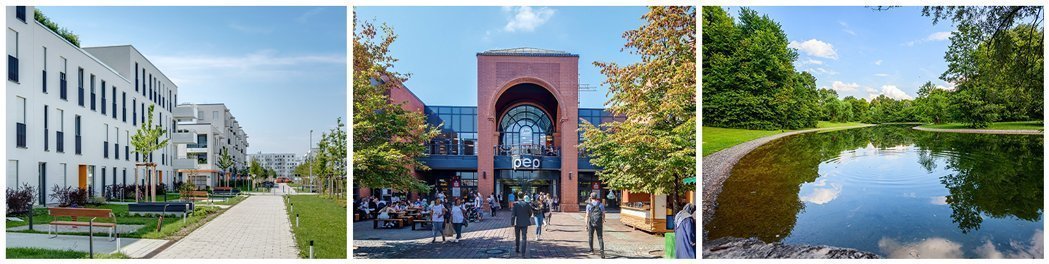
Leisure and recreational opportunities in Ramersdorf are often located right in the immediate vicinity. The Michaelibad and Ostpark —two major facilities—are within easy reach and offer opportunities for sports, recreation, and outdoor activities. As a result, residents benefit from being close to attractive recreational areas, while Ramersdorf itself is primarily known as a residential area with good transportation connections.
A particular strength of Ramersdorf is its visible historical depth. Places like Maria Ramersdorf, the old town center, and the model settlement ensure that the neighborhood does not feel generic. Anyone looking for a location in Munich with historical roots, without sacrificing good transportation links, will find a distinctive character here. This assessment is based on editorial analysis of urban and cultural history sources.