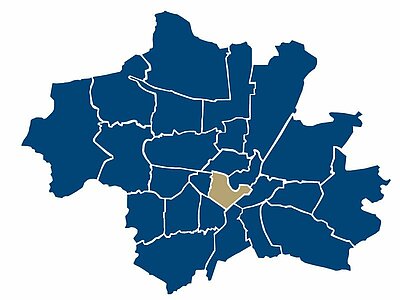
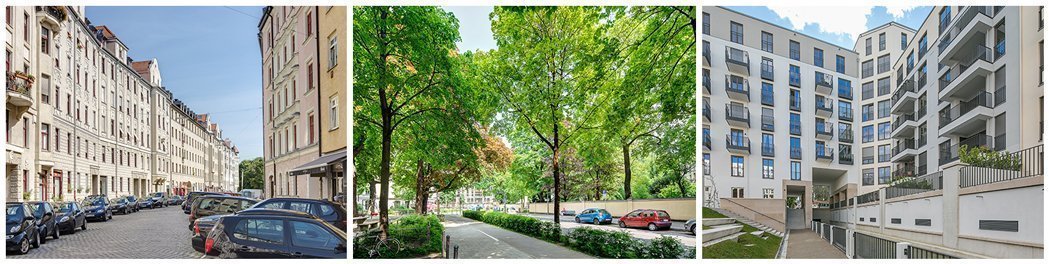
The Schlachthofviertel is located in City District 2, Ludwigsvorstadt-Isarvorstadt, and is thus one of Munich’s inner-city residential neighborhoods. The city describes the Schlachthof, Glockenbach, and Gärtnerplatzviertel as apartment and commercial districts that emerged from urban expansions during the Gründerzeit era, featuring a large stock of older buildings that remains largely well-maintained to this day.
From a residential perspective, this is precisely what matters: The Schlachthofviertel is not merely a trendy phenomenon of recent years, but a well-established inner-city neighborhood with a robust building stock and its own history.
The cultural history trail traces the neighborhood’s origins to the area around the Südbahnhof and describes the area between Lindwurmstraße and Thalkirchner Straße —before urban development took hold—as one characterized by fields, gardens, and a few access roads. It was not until the 1870s that the area, with its slaughterhouse, livestock market, and railroad, began to gain significant momentum.
From a residential and navigational perspective, the Schlachthofviertel is most often considered in conjunction with Isarvorstadt, the Dreimühlenviertel, the Glockenbachviertel, and Ludwigsvorstadt.
The neighborhoods differ significantly: toward Glockenbach, the area becomes more residential; in Ludwigsvorstadt, it is denser and has heavier traffic; and in the Dreimühlenviertel, it is more strongly shaped by the Isar River and waterways. The Schlachthofviertel lies precisely at this transition point and benefits from all three characteristics.
From a residential perspective, the Schlachthofviertel thrives above all on its unusual mix of historic buildings, remnants of commercial activity, culture, and the practicality of inner-city living. The city explicitly describes the area as a neighborhood with a high concentration of historic buildings; the cultural history trail also illustrates how closely the neighborhood’s development was linked to the Südbahnhof, the Viehhof, the Schlachthof, and later the Großmarkthalle. It is precisely this that creates a cityscape that seems less polished than classic upscale neighborhoods, but is instead more authentic, rugged, and often more distinctive.
At the same time, the neighborhood has gained significant cultural prominence in recent years. The city cites the “Wirtshaus im Schlachthof” as a venue for art and culture known far beyond Munich; on the adjacent Viehhof grounds, additional cultural anchors have emerged, including the “Bahnwärter Thiel,” an open-air cinema, and other cultural institutions. Added to this in 2021 was the new building for the Münchner Volkstheater. For tenants and prospective buyers, it is precisely this development that matters: Today, the Schlachthofviertel is not only historically interesting but also a neighborhood with a noticeably enhanced cultural and livability experience.
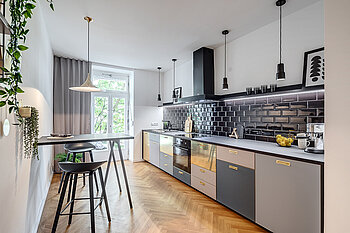
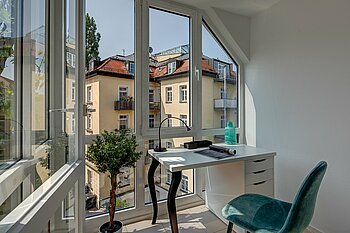
The neighborhood is particularly well-suited for working professionals seeking a central location, creative and culturally-minded households, as well as international residents. The neighborhood also offers ideal conditions for people looking for furnished, short-term housing in an urban setting rich in character. The key factors are, above all, the central location, the established stock of older buildings, the diverse cultural offerings, and the short distances within the city center.
| To the center (Marienplatz) | To the central station | To the airport |
|---|---|---|
| 2,8 km | 2,1 km | 44,0 km |


With the Volkstheater, the Wirtshaus im Schlachthof, Bahnwärter Thiel, and other cultural venues, the neighborhood today boasts a remarkably high concentration of cultural offerings for its size. The city itself explicitly identifies these institutions as part of the neighborhood’s profile. This is relevant from a residential perspective because cultural life here doesn’t just take place in the city center, but right in one’s own neighborhood.
An important part of the neighborhood’s character stems from its proximity to the Großmarkthalle and the former market and slaughterhouse sites. The city points out that, since the end of livestock trading, these areas have continued to host commercial businesses that benefit from their proximity to the slaughterhouse and wholesale market sites. This structure ensures that the neighborhood still stands out today from purely residential inner-city areas.
Tumblingerstraße, with its legalized graffiti wall, is one of the neighborhood’s most recognizable landmarks. The Cultural History Trail specifically identifies it as Munich’s oldest legalized graffiti wall—a true “Hall of Fame.” This is particularly valuable for the site because it makes the creative, unconventional, yet locally rooted character of the Schlachthofviertel very tangible.