
Starnberg is located on the northern shore of Lake Starnberg and, as the county seat, serves as the region’s most important urban hub. This role is precisely what makes it so attractive as a place to live: Residents don’t just live by the lake, but in a place with its own downtown, train station, cultural offerings, schools, and amenities—a place that functions in a much more urban way than many other lakeside communities.
At the same time, Starnberg thrives on its spatial layout. The train station, lakefront promenade, Schlossberg, and city center are all located in close proximity to one another, making the town particularly easy to navigate. Urban development documents explicitly note that the train station, Schlossberg, and Tutzinger-Hof-Platz are important centers within the urban space, each with its own distinct character. It is precisely this multi-polar structure that makes Starnberg interesting from a residential perspective.
From a residential and locational perspective, Starnberg is particularly often considered in conjunction with Tutzing, Feldafing, Berg am Starnberger See, and Icking. This makes sense from a search logic perspective: These towns share similar residential attractions—such as lakeside locations, proximity to nature, high quality of life, and good connections to Munich—but differ, in some cases significantly, in terms of urban character and infrastructure.
From a residential perspective, Starnberg is particularly appealing to people who are looking for a desirable location, proximity to the lake, and a high-quality living environment, but who don’t want to sacrifice good access to Munich. Unlike a typical quiet suburb, Starnberg thrives not only on its natural scenery but also on its urban infrastructure. The city offers daycare centers, several elementary schools, a middle school, a high school, a vocational high school (FOS), and other educational institutions right in town.
Added to this is a very reliable framework for daily life. The public library is centrally located in the Zentrum; the official Department of Education and Social Services visibly brings together schools, daycare centers, sports, and social services. As a result, Starnberg doesn’t come across as merely a lakeside vacation destination, but rather as a place to live where family life, work, and leisure blend seamlessly. (starnberg.de)
This residential area is of interest, for example, to the following people:
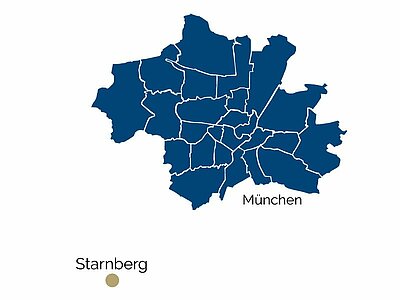
| To the center (Marienplatz) | To the central station | To the airport |
|---|---|---|
| 26,9 km | 25,9 km | 63,3 km |


Key location advantages include the promenade, access to the water, and boat service. The official Bavarian Lake Navigation Authority refers to Starnberg as the gateway to Lake Starnberg; the pier is just a few minutes’ walk from the train station. For residents, this is a real added value, because lake-based recreation, walks, and scenic views are not only available in the wider surrounding area but are also part of their everyday lives.
People who live in Starnberg usually choose not just for the lake, but deliberately for a place with an urban center, strong infrastructure, and a distinct identity. This is precisely what sets Starnberg apart from many smaller lakeside towns: the city is not merely a backdrop, but a place to live that offers a wide range of everyday experiences. This classification is a well-founded assessment based on population size, its role as a county seat, rail connections, and educational opportunities.
One of Starnberg’s key locational advantages lies in its educational and childcare infrastructure. Official records show numerous daycare centers, after-school care options, and 14 schools in total, including several elementary schools, a middle school, a high school, a vocational high school (FOS), and other types of schools. This is particularly relevant for families because travel distances are short and the range of services available right in town is extensive.