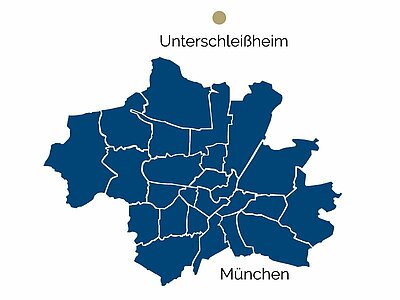

Unterschleißheim is located about 20 kilometers north of downtown Munich and benefits from its location between the A92, B13, the airport corridor, and the S1 S-Bahn line. This makes the town particularly appealing to anyone who wants to live in northern Munich but doesn’t want to sacrifice quick access to Munich, Freising, or the airport. At the same time, the town feels significantly quieter and greener in everyday life than many locations immediately adjacent to the city.
From a residential perspective, it is important not to view Unterschleißheim as a single, homogeneous town. Official planning documents identify the districts of Unterschleißheim, Lohhof, and Hollern as the main residential areas; in addition to Lohhof-Süd in the southwest and the Riedmoos settlement west of the town center. This is precisely what gives rise to different living experiences—ranging from locations near the train station and town center that are well-suited for daily life to quieter, more outlying areas with a stronger connection to recreation and the natural landscape.
In the immediate vicinity, Eching, Garching, Oberschleißheim, Haimhausen, and Hebertshausen are particularly relevant. As a result, Unterschleißheim functions not only as a place to live for commuters to Munich but also as a practical everyday hub for accessing the entire northern metropolitan area. When comparing places to live in the northern Munich suburbs, one can also consider Lohhof, Oberschleißheim, Eching, Garching, and Haimhausen.
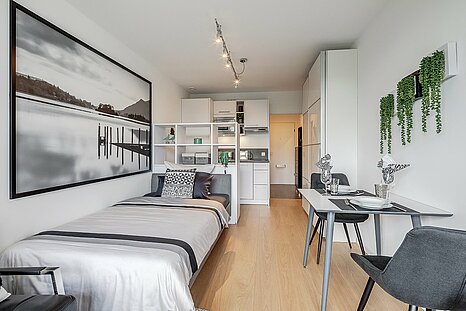
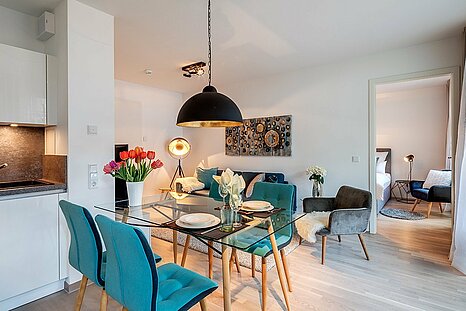
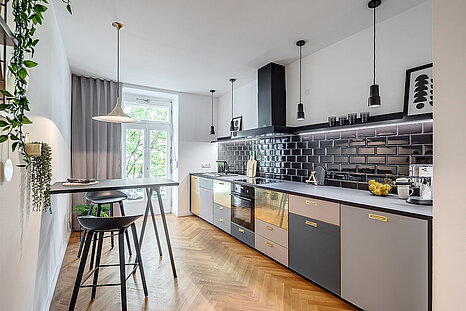
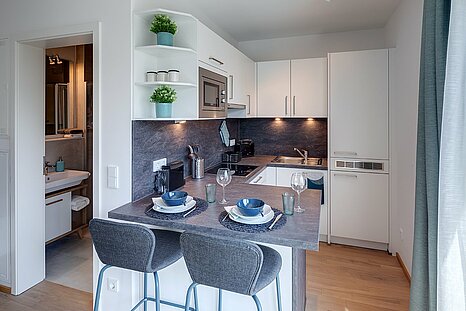
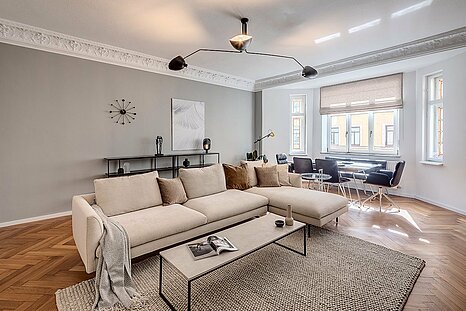
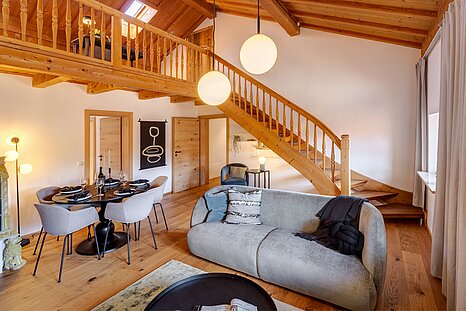
Life in Unterschleißheim is characterized by a mix of established residential areas, functional central corridors, and clearly identifiable recreational and green spaces. The residential landscape consists primarily of single-family homes and townhouses, supplemented by furnished apartments. In addition, there is an older village center, residential areas such as Am Weiher, local shopping districts, and several educational institutions.
Taken together, this creates a place to live that feels more focused on everyday life than spectacular —which is precisely what many people find appealing. Unterschleißheim is particularly attractive to families, commuters, professionals who work from home part of the time, international professionals in northern Munich, and those seeking high-quality temporary housing outside the city center.
The city offers a wide range of childcare options, a large selection of schools, and a combination of sports, culture, and amenities that is unusually dense for the surrounding area.
This neighborhood is appealing, for example, to the following people:
| To the center (Marienplatz) | To the central station | To the airport |
|---|---|---|
| 24,7 km | 29,2 km | 20,7 km |


Unterschleißheim is clearly organized to meet local needs. The town center at Rathausplatz brings together key services and the Isar-Amper-Zentrum; another important shopping center is located on Bezirksstraße. In addition, according to the city, there is a weekly market at City Hall every Wednesday and Saturday. This is not merely an event-based initiative, but a practical, neighborhood-based supply model suited for everyday life.
The recreational value of its green spaces is one of Unterschleißheim’s strongest location factors. The city cites Berglwald, Lohwald, the proximity to Mallertshofer Holz, Unterschleißheim Lake, Rolf-Zeitler Park, and the pond on Furtweg as important recreational areas, among others. In addition, there are cycling and walking trails, particularly toward Riedmoos, which is officially designated as a local recreation hub.
In terms of sports facilities, Unterschleißheim is exceptionally well-equipped for a city of its size. The city’s brochure lists, among other things, indoor and outdoor tennis courts, bowling alleys, several gyms, streetball courts, a stadium, and the sports center at the BallhausForum. In addition, there’s the AquariUSH with outdoor thermal water pools, a sauna, and a sunbathing area; at the Sportpark, a skate and inline skating area rounds out the offerings.