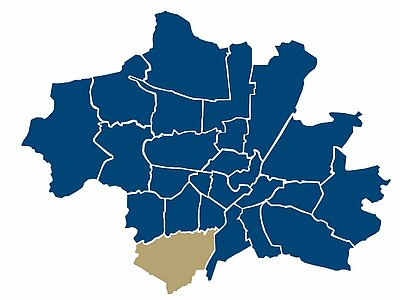

Parkstadt Solln is located in southern Munich within City District 19 and, in practical terms, is part of the residential area between Alt-Solln and Forstenried. The City of Munich describes the entire district as a large southern suburban district with very diverse subareas; According to the city, Solln itself is considered one of the most desirable residential areas with a garden-city character, while Parkstadt Solln is regarded as part of the district’s larger residential complexes. This is important from a residential perspective because, although Parkstadt Solln is clearly located in Solln, it has its own distinct character as a neighborhood.
Spatially, Parkstadt Solln can be easily explained through a few clear reference points: Drygalski-Allee, Gulbranssonstraße, Stäblistraße, its proximity to Alt-Solln to the east, and the open green spaces and landscapes toward Forstenried and Warnberger Riedel. The city’s open space concept for the Südpark park mile explicitly highlights the connection between Parkstadt Solln, the Solln village center, Forstenried, and Sendlinger Wald/Südpark. It is precisely this location between the built-up residential neighborhood and the open landscape that makes the quality of life tangible.
Parkstadt Solln is surrounded in particular by Solln, Forstenried, Fürstenried, and Obersendling. The residential profiles differ significantly: Old Solln is more characterized by villas and garden city structures; Parkstadt Solln appears more spacious and features multi-story buildings; Fürstenried is more oriented toward large housing developments; and Obersendling is more urban and closer to workplaces.
Parkstadt Solln is an attractive residential area primarily because it combines large-scale housing development with green living in a way that is unique to Munich. Built in the late 1960s, this large housing complex of multi-story buildings was designed to include numerous green spaces and open areas. Construction began as early as 1965 on approximately 2,000 new apartments. This gave rise to a self-contained residential neighborhood with generously proportioned open spaces.
In terms of urban planning, Parkstadt Solln clearly differs from Alt-Solln. While Solln is predominantly characterized by a scattered mix of single-family homes and villas, Parkstadt forms a denser and more modern residential district. It is precisely the combination of its proximity to Solln, its larger residential development structure, and its abundance of green spaces that defines the neighborhood’s unique character.
Parkstadt Solln appeals to a variety of resident groups:
| To the center (Marienplatz) | To the central station | To the airport |
|---|---|---|
| 10,0 km | 8,0 km | 45,0 km |


Parkstadt Solln is well-equipped to meet daily needs. Stores for everyday necessities are located right in the neighborhood; thanks to bus service, other amenities in Solln, Fürstenried West, and the surrounding areas are also quickly accessible. As a result, Parkstadt Solln feels peaceful without being isolated from everyday life.
A major advantage of Parkstadt Solln is the balance between quiet living and proximity to the city. The neighborhood is not as village-like as Alt-Solln, not as large-scale as Fürstenried, and not as urban as Obersendling. It is precisely this middle ground that makes it appealing to many types of home seekers. This classification is an editorial assessment based on location, settlement structure, and transportation links.
The greatest recreational value lies in the many small green spaces within the neighborhood and the larger open spaces on its outskirts. Additional landscape and path connections exist between Parkstadt Solln, Forstenried, and Warnberger Riedel, which expand the neighborhood’s access to green spaces. As a result, open space is already a defining feature of the residential area and can be interconnected even more effectively in the future.