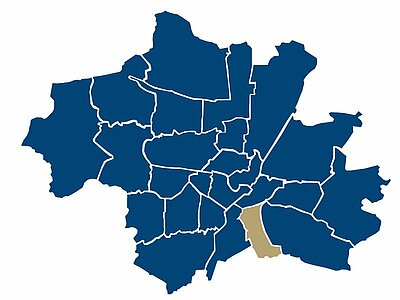
Obergiesing is located in the northern part of the Obergiesing-Fasangarten district and can be easily identified geographically by its location on the eastern Isar high terrace. The entire city district extends as a narrow strip between the southeastern section of the Mittlerer Ring and the S-Bahn line, encompassing both Alt-Giesing and more recently developed suburban areas.
The older part of Obergiesing is particularly significant as a residential area. It is densely built-up, has an inner-city character, and is at the same time recognizable as a distinct neighborhood with a clearly identifiable character.
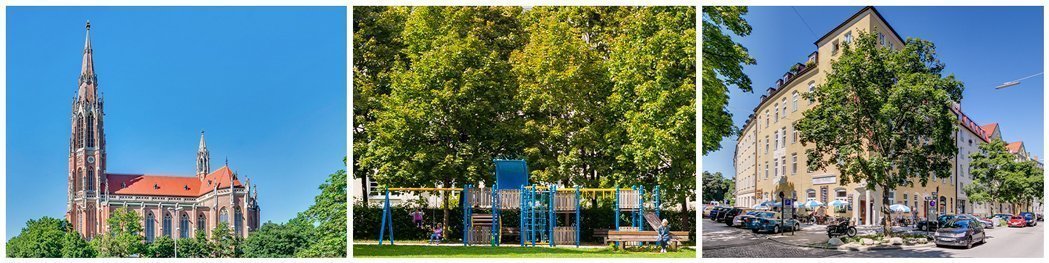
Among the most important landmarks is the Giesing Berg. For centuries, it has connected the historic town center on the edge of the hillside with the lower-lying residential areas. Tegernseer Platz serves as a central focal point in Old Giesing, while the Heilig-Kreuz Church continues to shape the neighborhood’s skyline and cityscape to this day.
It is precisely the combination of its unique topography, rich history, and good transportation access that gives Obergiesing its unmistakable character and makes this residential area easily recognizable within Munich.
From a residential and navigational perspective, Obergiesing is often considered together with Giesing, Untergiesing, Fasangarten, and the Au. In this context, the district occupies an interesting transitional position between different residential worlds in Munich.
Toward Untergiesing, the area is more strongly shaped by the Isar River and waterfront residential areas. Toward the Au, the city center draws nearer, while in the direction of Fasangarten , the development is more low-density and characterized by a residential character.
Obergiesing is thus situated between several very different residential structures and combines inner-city density, established neighborhood structures, and good accessibility with proximity to quieter and more open residential areas. It is precisely this versatile transitional location that contributes significantly to the neighborhood’s appeal.
From a residential perspective, Obergiesing is characterized above all by its diverse and heterogeneous building structure. In this neighborhood, single-family homes and smaller residential areas coexist with low-density multi-story apartment buildings and densely built-up block structures. This creates a varied urban landscape that resembles neither a classic, uniform neighborhood of older buildings nor a purely postwar neighborhood.
It is precisely this mix that makes Obergiesing appealing for a variety of housing needs. Depending on the specific area, you’ll find quieter, more residential streets as well as more urban and densely built-up locations. This lends the neighborhood a special versatility and a clearly recognizable character of its own.
Historically, Obergiesing was long characterized as a working-class neighborhood. Over time, however, the district continued to evolve and transformed into a modern residential and urban neighborhood with a wide range of services. Today, only a few businesses and architectural remnants bear witness to its former industrial character.
For residents, Obergiesing thus combines history, established structures, and contemporary living standards. To this day, the neighborhood retains areas with an unmistakable character, yet it also feels urban, practical for everyday life, and versatile —a combination that makes Obergiesing an attractive place to live in Munich.
This residential area is of interest, for example, to the following people:
| To the center (Marienplatz) | To the central station | To the airport |
|---|---|---|
| 5,0 km | 5,8 km | 42,2 km |


A major advantage of Obergiesing is its excellent everyday accessibility. Via the Giesing train station, Wettersteinplatz, and St.-Quirin-Platz, numerous destinations in Munich can be reached quickly and easily.
This makes the neighborhood particularly well-suited for people who want to live centrally while also benefiting from good connections to various parts of the city. Obergiesing thus offers an interesting alternative to traditional, high-priced neighborhoods with older buildings in even more central locations.
The combination of good accessibility, an urban living environment, and a comparatively diverse mix of building types makes Obergiesing an attractive residential area for anyone who values short distances and a high level of practicality in daily life.
The dining scene in Obergiesing reflects the character of the neighborhood: diverse, down-to-earth, and without any pretentious flair. Especially along Tegernseer Landstraße, you’ll find a varied mix of traditional Munich pubs, cafés, international cuisine, and modern restaurants. Even more sophisticated dining concepts have a place here.
It is precisely this diversity that makes the neighborhood so pleasant for everyday life. From a quick coffee to a simple lunch to an evening out at a restaurant, there are numerous options right in the neighborhood. The dining scene doesn’t feel like just a nightlife district, but is closely integrated into the neighborhood.
For residents, this creates a vibrant dining scene with everything close at hand, reflecting Obergiesing’s time-honored yet modern character.
Despite its dense development, Obergiesing offers several attractive open spaces for leisure and recreation. Of particular importance are Weißenseepark and Katzenbuckel, which together form a large, contiguous green space and recreational area. Sprawling meadows, mature trees, play areas, and paths provide opportunities for walking, playing, exercising, and relaxing.
The Giesinger Grünspitz offers a more urban atmosphere. This public green space on Tegernseer Landstraße serves as a neighborhood gathering place, featuring seating areas, table tennis, a community garden, and a variety of activities. In this way, Obergiesing combines classic green spaces with lively public areas.
Added to this are the excellent transportation connections, which also provide quick access to the Isar River and other recreational areas in Munich. As a result, the neighborhood offers residents a compelling mix of urban life and recreational opportunities close to home.