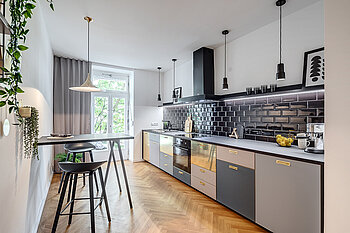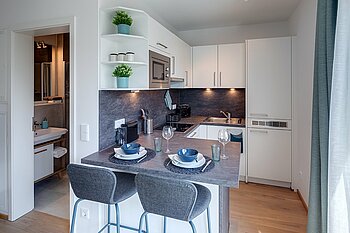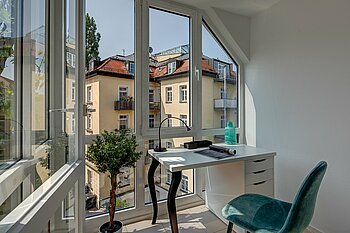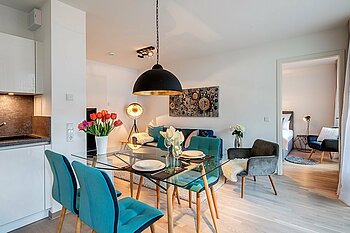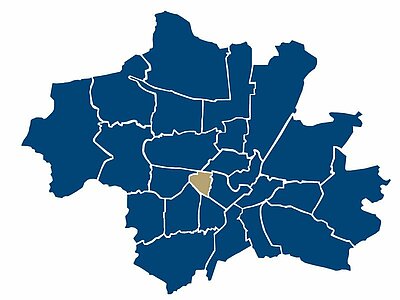
Westend essentially corresponds to Schwanthalerhöhe, Munich’s 8th district. The city describes it as the western edge of the city center, bounded by the Hauptbahnhof–Pasing and Hauptbahnhof–Ostbahnhof rail lines. From a residential perspective, this is a major advantage: The neighborhood is not only close to the city center but is also very clearly situated between the downtown area, the railroad tracks, and neighboring districts.
At the same time, Westend is not merely a transit area. The official district description closely links the neighborhood’s origins to industrialization and the resulting highly dense, Gründerzeit-style block development. To this day, nearly half of the housing stock dates from before 1919. It is precisely this architectural density and historical depth that make the neighborhood so distinctive from a residential perspective.
Surrounding Westend are several urban areas— Ludwigsvorstadt, Sendling, Laim, Neuhausen, and the outskirts of Schwanthalerhöhe —each with its own distinct character. Due to its location on the western edge of the city center, the neighborhood is closely connected to these adjacent areas.
It is precisely this transitional location that makes the Westend particularly interesting. Residents benefit from short commutes to the city center, while also enjoying quick connections to the western and southern parts of the city. As a result, the neighborhood combines a well-established neighborhood character with a very central location.
The Westend is particularly appealing as a residential area because it combines established structures with urban renewal. The neighborhood is characterized by numerous older apartment buildings, many of which date back to the turn of the century. At the same time, the area has evolved and modernized significantly over the years without losing its unique character.
What was once a working-class neighborhood has evolved into a vibrant inner-city residential area that combines historic architecture, diverse communities, and convenient access to local amenities. The Westend has an urban and lively feel, yet retains a palpable down-to-earth quality and a neighborhood character that has developed over time.
The Westend is particularly well-suited for:
| To the center (Marienplatz) | To the central station | To the airport |
|---|---|---|
| 4,5 km | 2,2 km | 40,3 km |


The Westend is also well-equipped to meet everyday needs. A variety of stores and services ensure that many errands can be run right in the neighborhood or with just a short trip. It is precisely this combination of a central location and a well-functioning local retail scene that makes the neighborhood particularly well-suited for everyday life.
The dining options are spread across various parts of Westend. Cafés, bars, and restaurants are firmly integrated into the neighborhood’s fabric, without the area being concentrated exclusively in individual entertainment districts. This creates a vibrant atmosphere while also reinforcing the neighborhood’s established residential character.
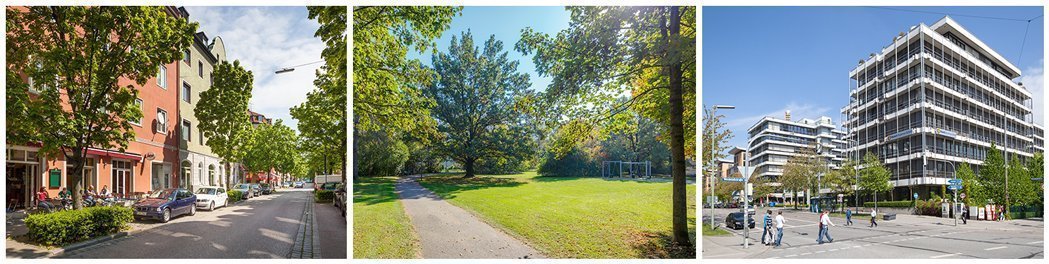
Bavariapark is an important green space and recreational area located right in the neighborhood. Meadows and open spaces offer opportunities for relaxation, picnics, and outdoor recreation. Especially in a densely built-up inner-city neighborhood, the park provides a valuable respite from everyday urban life.