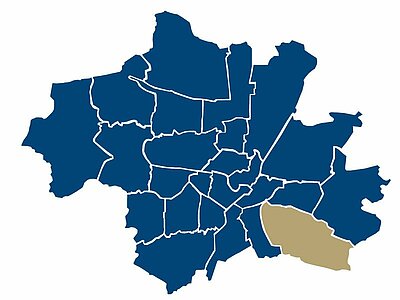
Perlach is located in the Ramersdorf-Perlach district in southeastern Munich. The district stretches from the city limits of Munich to areas near the city center around Ostbahnhof. Perlach is often divided into several distinct subareas, notably Altperlach, Neuperlach, and Waldperlach. This diversity offers those looking for housing a variety of neighborhoods and living arrangements within a single district.
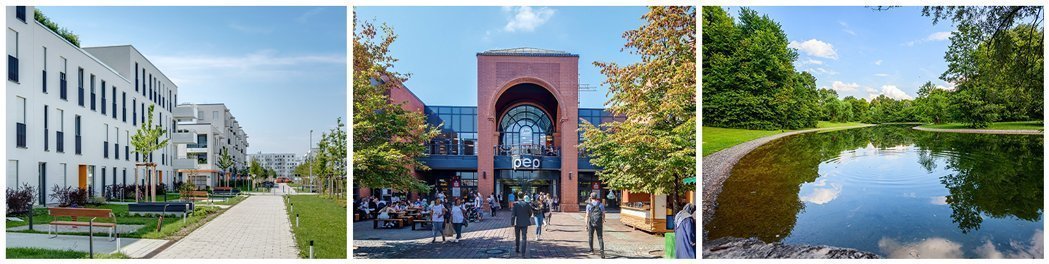
Several well-known landmarks help with spatial orientation. Pfanzeltplatz forms the historic Zentrum of Altperlach, while Ostpark serves as an important green space and recreational area. Large residential neighborhoods, as well as numerous shopping and service options, are located around the Zentrum of Neuperlach. Toward Hachinger Tal and Perlach Forst , the residential environment becomes increasingly green and offers additional opportunities for leisure and recreation.
Through these diverse areas, Perlach combines historically developed residential areas, urban neighborhoods, good access to amenities, and nature-oriented recreational spaces. As a result, the neighborhood offers those seeking housing clear spatial orientation and a wide range of options for living in southeast Munich.
Around Perlach, Ramersdorf, Neuperlach, Altperlach, and Waldperlach are particularly important points of reference. In addition, connections toward Giesing, Trudering, and the southern Munich suburbs also play a role.
This location is particularly appealing to those looking for housing because the living experience, surroundings, and transportation access can vary significantly depending on the specific micro-location. While some areas around the historic town center have a more village-like and quiet character, other residential areas offer a more urban environment with short distances and direct subway access.
This results in a wide variety of residential areas within and around Perlach, which—depending on personal preferences—offer both a quiet living environment and good access to Munich.
Perlach is a particularly diverse residential area, as the neighborhood combines a wide variety of residential zones. Around Altperlach, former farmhouses, open residential layouts, and the historic town center define the landscape. Toward Neuperlach, the residential character becomes more urban, functional, and on a larger scale. This diversity is complemented by the sparsely developed and greener areas around Waldperlach.
For those looking for a place to live, Perlach thus offers not just a single type of neighborhood, but a variety of housing options within a single district. The options range from existing apartments in established neighborhoods to family-friendly residential complexes, as well as modern apartments and larger residential complexes in the Neuperlach area.
Perlach is particularly attractive to people who are looking for more space, plenty of green areas, and good everyday amenities while still wanting to remain well-connected to Munich.
Typical reasons to live in Perlach include:
| To the center (Marienplatz) | To the central station | To the airport |
|---|---|---|
| 7,6 km | 9,3 km | 39,1 km |


For everyday needs, Perlach offers a good mix of local shops in the historic neighborhood and larger retail options in the Neuperlach area.
As a result, residents benefit from both short distances within their own neighborhood and a wider selection for larger purchases and errands. This combination makes Perlach particularly practical and convenient for everyday life.
Around Pfanzeltplatz and in its established residential areas, Perlach has a particularly neighborly and down-to-earth feel. Instead of a scene heavily focused on tourism or nightlife, the area is characterized by cafés, taverns, and restaurants suitable for everyday dining.
It is precisely this unpretentious mix that contributes to a pleasant living environment and makes Perlach a consistently attractive place to live for many people.
With Ostpark, the open spaces leading toward Hachinger Valley, and the area surrounding Perlacher Forest, Perlach offers numerous opportunities for walking, jogging, biking, and staying active in everyday life.
This proximity to green spaces and recreational areas is a major advantage, especially for families and working professionals. Here, leisure activities can be easily integrated into daily life without the need for long trips or elaborate planning.