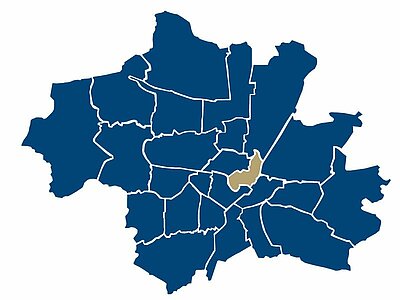
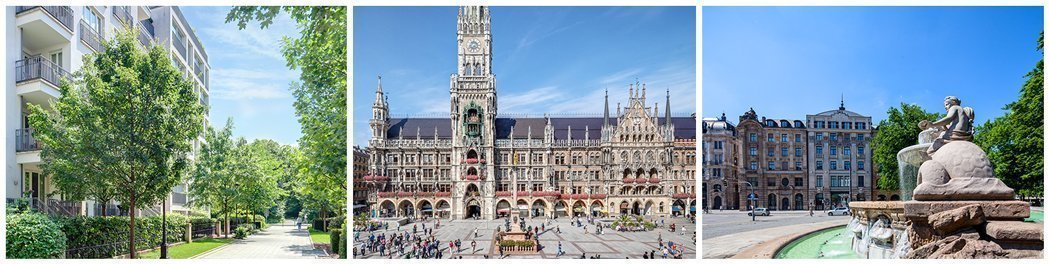
Munich’s Zentrum is located in the heart of the Altstadt-Lehel district. The historic Altstadt is largely bounded by the Altstadtring and marks the origin of Munich’s history, which dates back to 1158. Thus, the Zentrum is not only the geographical center but also the historical origin of Munich.
As a residential area, the Zentrum differs significantly from traditional neighborhoods. The cityscape is characterized by historic and prestigious buildings, museums, shops, offices, medical practices, cultural institutions, and bustling shopping streets. Accordingly, living here is less about tranquility and secluded residential streets and more about urban life, short distances, a central location, and an exclusive living environment.
It is precisely this combination of history, urban density, and close proximity to key amenities that defines the unique character of Munich’s Zentrum as a residential area.
Surrounding Munich’s Zentrum are several neighborhoods—including Altstadt, Lehel, Ludwigsvorstadt, and Maxvorstadt —that offer comparable features in terms of location, quality of life, and centrality.
Lehel, Altstadt, and Ludwigsvorstadt, in particular, are considered obvious alternatives to the Zentrum. Many properties in these neighborhoods also offer short distances, excellent infrastructure, and a central location, though some differ in that they have a stronger residential character or a quieter environment.
As a result, these neighboring districts are often directly compared to the Zentrum when searching for real estate and expand the range of centrally located residential areas in Munich.
The Zentrum in Munich is one of the city’s most sought-after and exclusive residential areas. Its particular strength lies in its exceptional central location: living here means, above all, short commutes, immediate proximity to key amenities, and a life right in the heart of the city.
At the same time, the housing supply is limited. There are only a few traditional residential buildings in the Zentrum, while offices, shops, medical practices, banks, cultural institutions, and other inner-city uses dominate much of the cityscape. It is precisely this mix that makes the location special and, at the same time, leads to a severe shortage of housing.
From an urban planning perspective, the Zentrum is also characterized by great diversity. The northeastern area is dominated by the Residenz complex, while the former Kreuzviertel has traditionally been more heavily influenced by banks and offices. Added to this are significant historic commercial and transportation corridors between Karlsplatz and Isartor, as well as between Odeonsplatz and Sendlinger Tor.
As a result, there is no uniform residential district, but rather a multitude of very different neighborhoods. Depending on the specific area, the character ranges from prestigious and historic to bustling and functional, and even to culturally rich and shopping-oriented. It is precisely this diversity that defines the unique character of Munich’s Zentrum as a residential area.
| To the center (Marienplatz) | To the central station | To the airport |
|---|---|---|
| 0,7 km | 2,7 km | 38,1 km |


The main shopping streets in the Zentrum of Munich run between Karlsplatz and Isartor, as well as between Odeonsplatz and Sendlinger Tor. Their routes follow the historic trade routes of the Altstadt and continue to shape the structure of the city center to this day.
Added to this is the central pedestrian zone featuring Kaufingerstraße and Neuhauser Straße, which is among Munich’s best-known shopping areas. Numerous stores, department stores, restaurants, and cafés are concentrated here in a small area.
Those who live in the Zentrum thus reside in one of Munich’s most important shopping and strolling districts and benefit from a particularly wide range of options right on their doorstep.
With the Viktualienmarkt, traditional taverns, numerous cafés, and upscale restaurants, the Zentrum in Munich boasts a particularly diverse culinary scene. The Viktualienmarkt is a central hub for specialties from around the world.
This offering is complemented by many well-known Bavarian restaurants, classic taverns, and modern dining concepts. This results in an exceptionally high concentration of options for dining, indulgence, and spontaneous restaurant visits.
It is precisely this combination of culinary diversity, short distances, and urban daily life that makes living in the Zentrum particularly attractive for anyone who wants to naturally integrate dining into their daily routine.
The Zentrum in Munich is an attractive yet very unique residential area. The high volume of visitors, the limited housing supply, and the vibrant mix of residential, commercial, retail, dining, and cultural offerings significantly shape everyday life.
Above all, its exceptional central location takes center stage. Those who live here consciously choose short distances, an intense urban environment, and immediate proximity to the city center’s many amenities. Peace and quiet, on the other hand, play a lesser role than in traditional residential neighborhoods.
Added to this is a correspondingly high price level. The Altstadt and Lehel are among Munich’s most expensive residential areas in terms of rent and purchase prices. Combined with the limited supply, this makes the Zentrum a scarce, exclusive, and highly sought-after place to live.