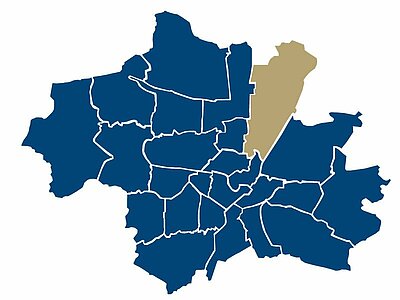
Denning is located in the eastern part of the Bogenhausen district. The district borders Englschalking to the north, Zamdorf to the south, the Arabellapark / Bogenhausen area to the west and the railroad line towards Daglfing to the east. As a result, Denning is located in an area that is clearly identifiable as a residential area on the one hand, but also allows short distances to other parts of Munich's north-east.
This location is particularly interesting from a residential perspective because Denning does not feel like a purely peripheral location. The district is comparatively quiet, but at the same time well integrated into the urban space. The city of Munich describes the entire district beyond the Mittlerer Ring as characterized by a small-scale settlement structure with detached and terraced houses; this is still particularly noticeable in Denning today.
Denning benefits from its proximity to several very different residential areas. There is a particularly close connection to Englschalking, Daglfing, Zamdorf and the adjoining areas of Bogenhausen to the west. Anyone looking to rent or buy an apartment in Denning therefore benefits not only from the quiet residential environment itself, but also from short distances to neighboring districts with additional infrastructure.
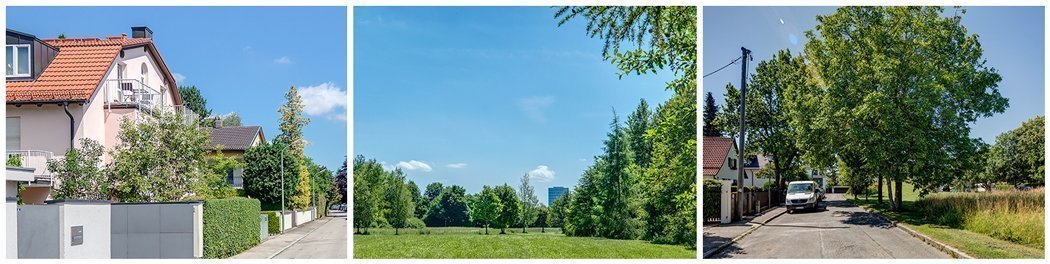
Denning is primarily a quiet residential district with a garden character. The townscape is characterized in many places by detached houses, smaller apartment buildings and well-kept properties, supplemented by apartment buildings with apartments. Thanks to this mature structure, Denning has developed into a high-quality, residential neighborhood that continues to impress with its tranquility, greenery and pleasant neighborhood atmosphere.
At the same time, Denning is neither a purely historical village center nor a purely new development area. According to the city, new housing estates were built to the west and east of Ostpreußenstrasse from the 1920s onwards, with further multi-storey residential buildings being added later. Today, this results in a residential pattern that combines established settlement areas, quieter residential quarters and, in some places, denser buildings.
Typical resident groups in the district are, for example
This classification results from the residential structure, the green spaces, the Ostpreußenstraße, which is suitable for everyday use, and the good accessibility via the S-Bahn in the surrounding area.
| To the center (Marienplatz) | To the central station | To the airport |
|---|---|---|
| 6,6 km | 8,1 km | 36,0 km |


Denning is well positioned for everyday needs - a shopping street with numerous stores, and NordOstKultur describes Ostpreußenstraße as a popular shopping street with over 100 stores, service providers and eateries. This keeps the district pleasantly practical for everyday use.
Denning is also suitable for everyday dining. Individual cafés, restaurants and smaller bars complement the residential structure of the district without Denning taking on the character of a distinct nightlife district. This fits in well with the overall picture: a quiet district with practical amenities, a pleasant neighborhood atmosphere and sufficient offers for everyday life.
One of Denning's great advantages is its open space and leisure facilities. With the Denninger Anger in the south, the Zamilapark and additional sports and exercise areas, the district offers good opportunities for recreation, exercise and everyday life in the countryside. Sports, tennis and fitness facilities also contribute to the fact that Denning not only appears quiet and residential, but also enables active leisure activities directly in the residential area. This is a clear added value, especially from a residential perspective.