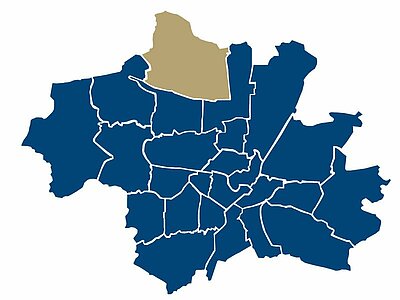
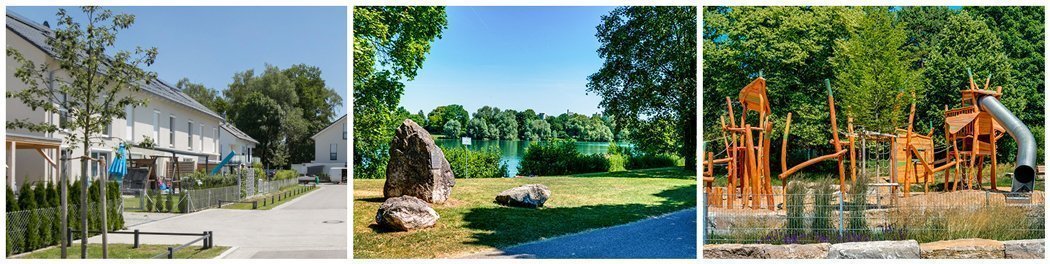
Fasanerie is located in the north of Munich and belongs to the district 24 Feldmoching-Hasenbergl. The location is particularly interesting from a residential perspective because it combines two qualities: On the one hand, the district is clearly located within Munich's urban area; on the other hand, the lake landscape and adjacent green areas give it a much more relaxed feel than many more densely built-up districts. The state capital describes the district overall as being strongly characterized by green spaces; this explicitly includes Fasaneriesee, Feldmoching See and Lerchenau See.
The Fasanerie is particularly impressive due to its location qualities: Fasaneriesee and Lerchenau Lake are just a few minutes' walk away, with Allach Lohe to the south. At the same time, the S-Bahn station on the S1 line provides a fast connection to the city center and the surrounding urban areas. This creates a residential environment that is close to nature without being cut off from urban life.
People who live in Fasanerie are not only oriented towards their own neighborhood in everyday life, but also towards the surrounding districts. The proximity to Feldmoching, Hasenbergl, Moosach and Lerchenau creates an environment that combines quiet living with good connectivity. Added to this is the proximity to the lake district in the north of Munich, which further enhances the leisure and recreational value. This is important for prospective residents because although the Fasanerie is quiet and self-contained, it is not isolated.
Fasanerie is primarily a small-scale residential area with a strong green focus. The existing Mr. Lodge site describes the development as a residential area with predominantly single-family and terraced houses. This is precisely what distinguishes Fasanerie from many other residential areas in Munich: instead of dense block structures or large-scale neighborhoods, a more restrained, residential-oriented image dominates here.
Historically, the estate developed as a colony on the former site of the electoral pheasant garden. The City of Munich's KulturGeschichtsPfad (CulturalHistoryTrail) records that a stopping point was created in 1892 following the new alignment of the Munich-Landshut railroad line and that the settlement of the Fasanerie colony increased from 1910. By 1912, it already comprised 43 estates with around 300 inhabitants. This development explains why the district still looks more grown up than planned and urban to this day.
Typical resident groups in the district include
This classification results from the residential structure, the proximity to the lakes, the S-Bahn connection and the overall residential character of Fasanerie.
| To the center (Marienplatz) | To the central station | To the airport |
|---|---|---|
| 11,9 km | 10,0 km | 35,3 km |


For everyday needs, Fasanerie offers a rather compact and everyday supply. Individual stores cover important basic needs on site, while larger shopping and supply facilities can be reached in the neighboring districts. The connection to the Olympia shopping center also extends the practical radius. As a result, Fasanerie remains quiet and residential without appearing cut off or isolated in everyday life.
The Fasanerie also remains rather restrained in terms of gastronomy - a few restaurants, bars and cafés. This underlines the residential orientation of the district: not over-staged, but solidly positioned for everyday life.
A major advantage of the Fasanerie is its immediate recreational value - there are three bathing lakes in the vicinity: Fasaneriesee, Lerchenau Lake and Feldmoching Lake. The city of Munich also describes the Fasaneriesee as a lake with a circular path, sunbathing lawns and barbecue areas; it is located between Lerchenau Lake and Feldmoching Lake and is part of the Dreiseenplatte in the north of Munich.